
Table of Contents
- Start With the Right Foundation: Skin Prep and Moisturizing
- Where to Spray Cologne: Pulse Points and Warm Areas
- How Many Sprays of Cologne to Use (by Strength and Setting)
- How Far to Hold the Bottle: The Six-Inch Rule and Spray Technique
- Cologne on Skin vs Clothes: Which Projects Better?
- How to Make Cologne Last Longer Without Over-Spraying
- Projection vs Longevity vs Sillage: What You're Actually Chasing
- How to Test Your Cologne Projection Objectively
- Climate, Skin Type, and Sensitivity: Adjusting Your Routine
- Conclusion: Build a Projection Routine That Works for You
- Frequently Asked Questions
Last Updated: October 8, 2026
Start With the Right Foundation: Skin Prep and Moisturizing
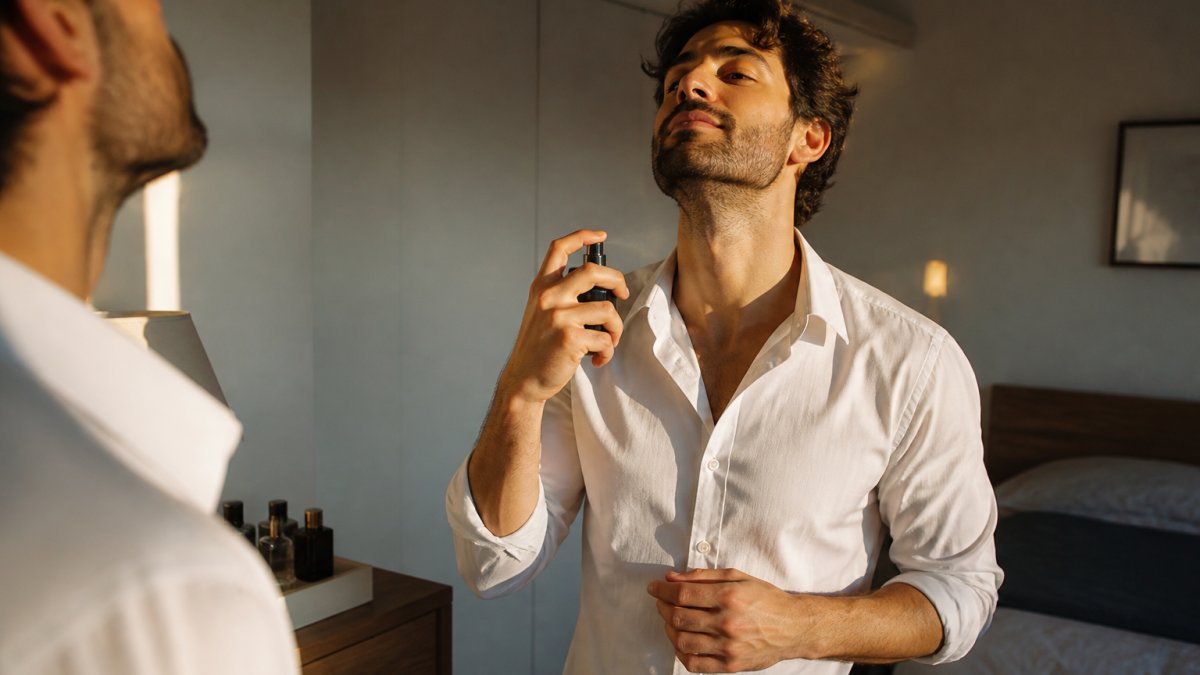
Dry skin is the most common reason cologne fades fast. Fragrance molecules need oil and moisture to cling to, and parched skin lets them escape within an hour or two. If you want to know how to apply cologne for maximum projection, the work starts before the bottle ever touches your body. This guide walks through prep, placement, spray counts, and testing so your scent carries without overwhelming a room.
Skin prep is the single biggest lever most people ignore. A simple routine takes 60 seconds and can add hours of wear.
Why Dry Skin Kills Projection
Fragrance evaporates faster on dry skin. Without moisture to hold the scent, top notes vanish and the base never gets a chance to bloom. Hydrated skin holds fragrance longer and releases it more steadily through the day.
The Unscented Lotion and Vaseline Method
A common approach is to moisturize right after a shower, while skin is still damp:
- Apply an unscented lotion to pulse points and let it absorb
- For extra hold, tap a thin layer of Vaseline on wrists and neck
- Wait a minute before spraying so the lotion sets
- Never use scented lotion, it competes with your cologne
Where to Spray Cologne: Pulse Points and Warm Areas
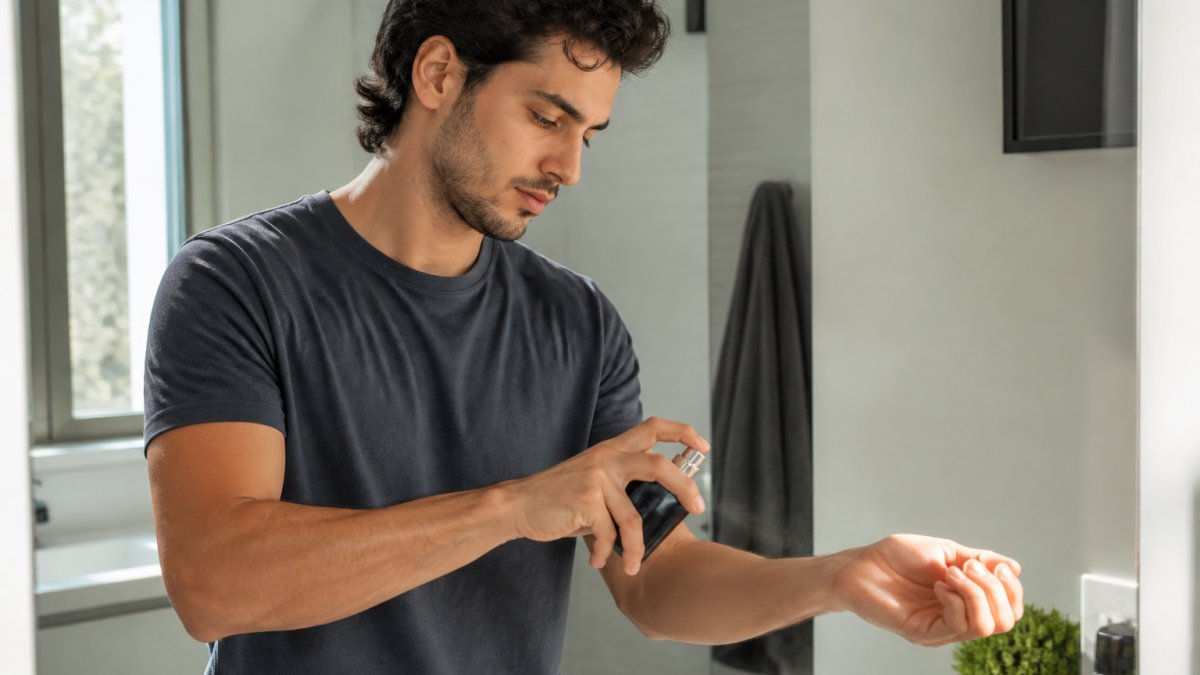
Pulse points are the best spots to spray cologne because body heat rises there and pushes the scent outward. Warmth activates fragrance and helps it project. Aim for areas where you can feel your pulse.
The Best Spots: Inner Wrists, Neck, Collarbone, Behind the Ears
These four spots do the heavy lifting:
- Inner wrists for a quick scent check through the day
- Hollow of the neck for steady diffusion near the face
- Collarbone for warmth and a strong scent trail
- Behind the ears for subtle, close-range projection
Spots to Avoid (and Why Rubbing Ruins Everything)
Never rub your wrists together after spraying. Rubbing crushes the top notes and speeds evaporation, which shortens wear and weakens projection.
Skip these spots:
- Hairline if you use styling products, they clash with scent
- Chest under a tight shirt, fabric traps the scent
- Back of the hand, it washes off fast
- Forearm and inner elbow only if you want a lighter, closer scent
How Many Sprays of Cologne to Use (by Strength and Setting)
Most guides hand you a spray count and walk away. That's useless for projection, because the right number depends on three variables at once: the concentration of the juice, the size of the room you're walking into, and how far you actually want the scent to travel. A spray count that projects perfectly across a dinner table will choke the person next to you in a car.
Here's the framework. Start with your concentration, then adjust for venue and desired reach.
Baseline Spray Counts by Concentration
| Concentration | Typical Oil Load | Baseline Sprays (neutral setting) |
|---|---|---|
| Body Spray / Splash | 1-3% | 4-5 |
| Eau de Cologne (EDC) | 3-5% | 3-4 |
| Eau de Toilette (EDT) | 5-15% | 2-3 |
| Eau de Parfum (EDP) | 15-20% | 1-2 |
| Extrait / Parfum | 20-40% | 1 |
These are starting points, not rules. The oil load is what determines how much scent is available to project, a single spray of extrait can out-throw four sprays of body spray because there's simply more fragrance material per press.

Adjusting for Venue and Desired Reach
Now layer in the setting. The tighter the space, the fewer sprays, but the closer you want the scent to sit, the more you can afford to concentrate it on fewer pulse points.
| Setting | Projection Goal | Adjustment from Baseline |
|---|---|---|
| Office / cubicle | Arm's length (2-3 ft) | -1 spray, keep to 2 pulse points |
| Dinner date across a table | 3-4 ft | Baseline, 3 pulse points |
| Bar or club | 4-6 ft | +1 spray, add collarbone |
| Outdoor event / festival | 6+ ft | +1 to +2 sprays, add chest and back of neck |
| Car or small meeting room | Under 2 ft | -1 spray, wrists only |
The Projection Ceiling
There's a hard limit to how much projection you can buy with sprays. Past a certain point, extra sprays don't extend reach, they just make the scent denser in the same radius. Most wearers hit that ceiling around 4-5 total sprays of an EDT or 2-3 of an EDP. Beyond it, you're not projecting further, you're just becoming the person people edge away from.
If you need more reach than your ceiling allows, the fix isn't more sprays. It's a higher-concentration fragrance, a more projection-friendly placement (see the pulse-point section), or a different scent profile, fresh citrus and aquatic notes tend to project wider but shorter, while heavy ambers and oud project closer but longer.
A Quick Calibration Method
If you're unsure where to start, pick the baseline for your concentration, wear it to the target setting, and ask one honest person whether they can smell you from the distance you care about. If yes, hold. If no, add one spray next time, not two. One-spray increments are the only way to find your personal ceiling without overshooting.
How Far to Hold the Bottle: The Six-Inch Rule and Spray Technique
Hold the bottle about six inches from your skin. Closer than that concentrates the spray in one wet spot, and farther than that wastes most of it into the air. Six inches gives an even mist that covers a wider area and projects better.
Technique matters as much as distance:
- Spray onto moisturized skin, not clothing
- Keep the nozzle steady and press once per spot
- Let the mist settle, never rub it in
- Spray pulse points last so the scent stays closest to your body heat
Cologne on Skin vs Clothes: Which Projects Better?
Skin projects better in the short term; clothes hold scent longer. Skin uses your body heat to push fragrance into the air, which is exactly what projection needs. Fabric traps scent and releases it slowly, so it lasts but travels less.
The smart move is to use both. Spray most of your cologne on skin, then add one light spray on a safe fabric layer for staying power.
Fabric-by-Fabric Guide: What to Spray and What to Skip
| Fabric | Spray? | Why |
|---|---|---|
| Cotton | Yes, light | Holds scent well, easy to wash |
| Wool | Yes, light | Absorbs and releases slowly |
| Silk | No | Stains and holds oil marks |
| Leather | No | Scent lingers and can damage finish |
| Synthetics | Skip | Traps scent oddly, hard to refresh |
How to Make Cologne Last Longer Without Over-Spraying
Lasting power comes from prep and placement, not volume. If your cologne fades by lunch, the fix is rarely "spray more." It's usually "moisturize better and spray smarter."
Sillage Oros Eau De Parfum Spray (Unisex) By Riiffs →
Try these:
- Moisturize pulse points before spraying
- Spray one spot on your shirt collar for a slow release
- Keep a travel atomizer for a midday touch-up on skin only
- Store the bottle away from heat and sunlight
- Layer with a matching body wash or lotion when you have one
Projection vs Longevity vs Sillage: What You're Actually Chasing
These three terms get used interchangeably, but they describe different physical behaviors, and you tune them with different levers. If your goal is maximum projection, you need to know which lever does what, because pulling the wrong one gives you a scent that lasts all day but nobody notices, or one that fills a room for twenty minutes and then vanishes.
The Three Dimensions, Defined
- Projection is how far your scent radiates from your body at a given moment. It's a radius, measured in feet. A fragrance with strong projection announces you from across a room.
- Longevity is how long the scent remains detectable on your skin. It's a duration, measured in hours. A fragrance with strong longevity is still there at bedtime.
- Sillage is the trail you leave behind as you move, the scent wake a person walks through after you've passed. It's a path, not a radius.
A fragrance can be strong in one and weak in another. A heavy oud might project two feet but last twelve hours. A bright aquatic might project six feet but disappear in three. Neither is better, they're different tools.
How to Tune Each One Independently
This is the part most guides skip. Here's which lever moves which dimension:
| Lever | Projection | Longevity | Sillage |
|---|---|---|---|
| More sprays | ↑ (until ceiling) | ↑ slightly | ↑ |
| Higher concentration (EDP vs EDT) | ↑ | ↑↑ | ↑ |
| Moisturized skin | ↑ slightly | ↑↑ | ↑ |
| Pulse-point placement | ↑↑ | ↑ | ↑ |
| Clothing application | ↓ | ↑↑ | ↓ |
| Scent profile (fresh vs heavy) | ↑ for fresh | ↑ for heavy | ↑ for heavy |
| Body heat (warm areas) | ↑↑ | ↓ slightly | ↑ |
Read the table by column. If you want projection, your highest-leverage moves are pulse-point placement and body heat, not spray count. If you want longevity, moisturizing and clothing application do more than anything else. If you want sillage, you need a heavier scent profile plus enough sprays to leave a trail.
Why Projection and Longevity Pull Against Each Other
The molecules that project well are the light, volatile ones, they evaporate quickly and carry far. The molecules that last are the heavy, low-volatility ones, they cling to skin and release slowly. A fragrance built for maximum projection is, by nature, burning through its most volatile materials fast.
This is why you can't simply spray more to get both. You can push projection up with placement and heat, and push longevity up with prep and concentration, but the fragrance's own molecular architecture sets the ceiling on each.
Matching the Dimension to the Occasion
- Crowded bar or club: Prioritize projection. You want to be detectable from a few feet away in a noisy, scent-saturated room. Pulse points, warm areas, baseline-plus-one sprays.
- All-day office: Prioritize longevity with low projection. You want a consistent, close scent that doesn't announce you across the cubicle farm. Moisturize well, spray wrists and chest, keep count low.
- Date night: Prioritize sillage. You want a trail that lingers in the air after you move, a scent someone notices when you lean in and again when you step away. Heavier profile, collarbone and neck placement.
- Outdoor event: Prioritize projection. Open air disperses scent fast, so you need more reach. Add sprays and use chest and back-of-neck placement where body heat is high.
Once you know which dimension the setting rewards, the application decisions in the rest of this guide become obvious rather than guesswork.
How to Test Your Cologne Projection Objectively
You can't smell your own scent accurately, so test it on someone else. Spray as usual, then ask a friend to stand a few feet away and tell you when they first notice it. That distance is your real projection.
A simple test routine:
- Spray on your normal spots and wait 15 minutes
- Have someone stand 3 feet away and step closer slowly
- Note the distance where they first catch the scent
- Repeat on a different day to compare
This gives you a real number instead of a guess.
Climate, Skin Type, and Sensitivity: Adjusting Your Routine
Heat and humidity amplify scent, while cold and dry air mute it. In summer, cut your spray count by one to avoid overapplication. In winter, moisturize more and expect to reapply sooner. Oily skin holds fragrance longer than dry skin, so dry-skin types should lean harder on prep.
If you have sensitive skin, patch-test new fragrances on your inner forearm first. Spray on clothing or a scarf instead of skin if a scent irritates you, and keep it away from broken or freshly shaved skin.
Conclusion: Build a Projection Routine That Works for You
Getting projection right is a routine, not a single trick. Moisturize, hit your pulse points, match your spray count to the setting, and test the result on a real person. Once you know how to apply cologne for maximum projection, you control the room without flooding it.
At Myriad Mart, we carry fragrances built for exactly this. The Sillage Oros Eau De Parfum Spray by Riiffs opens with Amalfi lemon, neroli, and raspberry over a warm amber and patchouli base, and its name says it all. The 1 Million Eau De Toilette Spray by Paco Rabanne brings grapefruit, cinnamon, and leather for a bolder evening trail. Both sit in our fragrance collection at prices that make building a rotation easy.

Frequently Asked Questions
Where should you spray cologne for the best projection?
Target pulse points where body heat is strongest: inner wrists, the hollow of the neck, collarbone, behind the ears, and inner elbows. Warmth helps the fragrance evaporate and rise, which is what creates projection. Spray two to three of these spots rather than concentrating everything in one place. Avoid rubbing after spraying, since friction breaks down the top notes and shortens how long the scent stays noticeable. For extra lift, a light spritz on the chest or hairline works well.
How many sprays of cologne should you use?
It depends on concentration. An eau de toilette typically needs three to four sprays for good cologne projection, while an eau de parfum needs only two to three because of its higher oil content. Body sprays can take four to six. For daytime or office settings, subtract one spray. For evening or outdoor events, add one. Start conservative and adjust based on feedback, since overapplication creates a heavy cloud that pushes people away instead of drawing them in.
Should you apply cologne to skin or clothes for better projection?
Skin gives you the best projection because body heat activates the fragrance and helps it diffuse upward. Fabric holds scent longer but releases it more slowly, so it contributes to longevity rather than projection. The best approach combines both: spray most of your cologne on pulse points and add one light spritz on a cotton shirt collar or chest area. Skip silk, leather, and delicate fabrics, since fragrance oils can stain or damage them.
Does moisturizing before applying cologne make it project more?
Yes. Dry skin absorbs fragrance oils quickly and releases them slowly, which weakens projection. Apply an unscented lotion or a thin layer of Vaseline to your pulse points before spraying. Hydrated skin holds the fragrance on the surface longer, letting body heat lift it steadily throughout the day. This one step can noticeably improve how far your cologne carries without adding extra sprays.
Building a scent routine that actually projects takes the right bottle and the right technique. Myriad Mart stocks a wide range of authentic designer fragrances at prices that beat the department stores, all in one place. Browse our fragrance collection and find your signature scent today.
