
Table of Contents
- Canvas Wall Art Placement: The Rules That Actually Work
- Canvas Print Size Guide: Match the Art to the Wall
- Gallery Wall Layout: Grids, Salons, and Everything Between
- Canvas Art Above Sofa: Getting the Proportions Right
- Room-by-Room Placement: Bedroom, Dining, Bath, and Entry
- Lighting, Glare, and the Conditions That Age Canvas
- Hanging Without Damage: Renters and Heavy Pieces
- Care, Cleaning, and Long-Term Preservation
- Conclusion: Hang It Once, Enjoy It for Years
- Frequently Asked Questions
Last Updated: October 7, 2026
Canvas Wall Art Placement: The Rules That Actually Work
Hanging canvas wall art is the fastest way to make a room feel finished, and a few simple measurements separate a wall that looks intentional from one that looks improvised. This guide from Myriad Mart covers where your eyes naturally land, how big a canvas should be, and how to hang it without guesswork.
The rules below are not style opinions. They come from how people actually look at a wall: eye level first, furniture second, empty space last. Get those three right and almost any piece works.
The 57-Inch Rule and Why Your Eyes Decide
The center of your canvas wall art should sit at 57 inches from the floor. That is the average human sightline, and it is the single most common mistake we see: art hung too high, floating near the ceiling.
Museums hang at this height for a reason. It puts the middle of the artwork where your gaze rests when you walk into a room, whether you are standing or seated nearby.
If you have high ceilings or tall furniture, adjust upward in small steps. Move it 2 to 3 inches, not 12. The goal is a natural sightline, not a ceiling border.
Center on Furniture, Not the Wall
Center canvas wall art over the furniture it relates to, not the room's midpoint. A sofa, bed, or console anchors the piece, and the eye reads the two as one unit.
That means a 60-inch sofa gets art centered on the sofa's width, even if the wall extends much further. Wide walls with off-center furniture look unbalanced when art is centered on the wall instead.
For a quick check, mark the furniture's centerline with painter's tape. Hang the canvas so its midpoint lines up with that line, and the whole arrangement settles into place.
Canvas Print Size Guide: Match the Art to the Wall
The right canvas print size is 60 to 75 percent of the width of the furniture below it. A 72-inch sofa pairs well with a canvas 43 to 54 inches wide. This is the canvas print size guide shortcut that solves most sizing questions.
Undersized art is the most common regret. A small canvas on a large wall reads as an accident, not a design choice. When in doubt, go bigger.
The 60 to 75 Percent Width Formula
Measure the width of your sofa, bed, or console. Multiply by 0.60 and 0.75. That range is your target canvas width.
- 60-inch sofa: 36 to 45 inches of art
- 72-inch sofa: 43 to 54 inches
- 84-inch sofa: 50 to 63 inches
For a gallery wall, the total width of the arrangement should fall in the same range. The individual pieces matter less than the group's footprint.
Standard Sizes and Where They Belong
| Size | Best Placement | Notes |
|---|---|---|
| 12x16 in | Bathroom, hallway nook | Small accent or pairing |
| 16x20 in | Entry, above a desk | Works in tight spaces |
| 24x36 in | Bedroom, dining room | Most versatile size |
| 30x40 in | Above a loveseat or console | Needs 8 to 10 in of clearance |
| 40x60 in | Above a large sofa | Anchor piece for big walls |
Measure your wall before ordering. Leave at least 8 to 10 inches of space between the top of the furniture and the bottom of the frame.
Gallery Wall Layout: Grids, Salons, and Everything Between
A gallery wall layout works when you pick one structure and commit to it. Grids feel calm and modern. Salons feel collected and layered. Mixing the two in one arrangement creates visual noise.
The grid is the safest starting point. Use same-size frames, align edges, and keep 2 to 3 inches between pieces. It reads as intentional even with mismatched artwork. For a grid of four 16x20-inch frames, the total footprint is roughly 34 to 38 inches wide and 42 to 46 inches tall once you add the gaps, measure that block against your wall before you buy anything.
The salon style stacks different sizes around a central anchor piece. Start with your largest canvas in the middle, then build outward, keeping the gaps consistent. A common pattern is a 24x36-inch anchor surrounded by 12x16-inch and 16x20-inch pieces, with 2 to 4 inches of breathing room between edges. Trace each frame onto paper and tape the templates to the wall before you commit to nails.
Here is the step-by-step that saves walls and tempers:
- Measure the wall area you want to fill. For a sofa wall, aim for the arrangement to span 60 to 75 percent of the sofa width.
- Lay the pieces on the floor in your planned layout. Adjust until the spacing feels even and the largest piece anchors the group.
- Cut paper templates for each frame and tape them to the wall at your planned height. Step back at least 10 feet and check the balance.
- Mark hook points on the templates, not the wall. For a wire-hung frame, pull the wire taut and measure the distance from the top of the frame to the peak of the wire, that is your hook offset.
- Install the center piece first, then work outward. This keeps the arrangement from drifting off-center.
For renters or anyone who wants to avoid patching holes, adhesive strips rated for picture hanging work on smooth painted walls. Use one strip per pound of weight as a starting point, press firmly for 30 seconds, and wait the full cure time on the package before hanging. For heavier pieces, a single small nail into a stud is often more secure than multiple adhesive strips.
If you are building the arrangement over time, start with the anchor piece and add one or two pieces per season. A gallery wall that grows gradually often looks more collected than one assembled in a single afternoon.
Canvas Art Above Sofa: Getting the Proportions Right
Canvas art above sofa placement comes down to one ratio: the art should span 60 to 75 percent of the sofa's width, with its center 57 inches from the floor. Get those two numbers right and the arrangement looks deliberate.
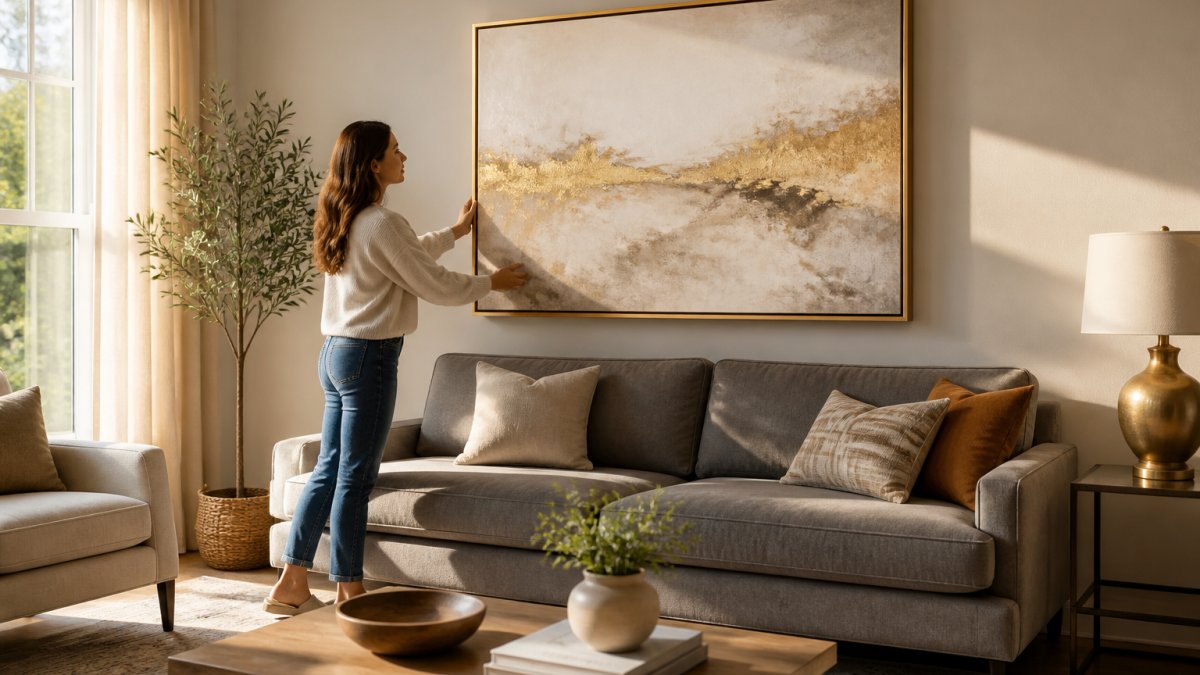
Leave 8 to 10 inches between the sofa back and the bottom of the frame. Closer feels cramped. Further up and the art drifts away from the furniture it should be anchored to.
For a sectional, treat the longest straight run as your reference width. For a sofa against a window, shift the art slightly toward the room's interior so glare does not wash out the surface.
Room-by-Room Placement: Bedroom, Dining, Bath, and Entry
Each room changes the rules slightly. What works above a sofa rarely works above a bed, and bathrooms need different materials entirely.
In the bedroom, center the canvas over the bed at 57 to 62 inches from the floor. A pair of matching vertical pieces often beats one wide canvas on a narrow wall.
In the dining room, hang art at seated eye level, roughly 57 to 60 inches. Guests look at the wall from a chair, so the center should fall slightly lower than in a standing room.
Sky Gold Abstract Painting Canvas Wall Art →
Bathrooms need moisture-tolerant pieces. A stretched canvas in a steamy room can warp over time, so keep it away from the shower's direct spray and consider a sealed or framed finish. In the entry, place art where it greets you at the door, usually on the wall opposite the entry point.
Lighting, Glare, and the Conditions That Age Canvas
Light is the biggest long-term threat to canvas wall art. Ultraviolet light fades inks, and direct sun does the most damage. A piece in full afternoon sun can lose its vivid color far faster than one in a shaded spot.
Keep canvas art out of direct sunlight when you can. If a sunny wall is your only option, a UV-filtering window film reduces the damage without changing the room's look.
Glare is the other problem. A glossy finish under a bright ceiling light turns the artwork into a mirror. Position lamps so light hits the canvas at an angle rather than straight on, and prefer a matte canvas finish in rooms with strong overhead lighting.
For accent lighting, a picture light mounted 12 to 18 inches above the frame throws an even wash across the surface. Aim it slightly downward so the top edge does not catch a hot spot.
Hanging Without Damage: Renters and Heavy Pieces
Renters can hang canvas wall art without losing a security deposit. Adhesive strips and hooks hold surprisingly well on smooth, painted walls, and they remove cleanly when you follow the package directions.
For larger pieces, adhesive hooks rated for the weight work, but use more than one and let the adhesive cure for the full recommended time before hanging. A stretched canvas is light for its size, which makes it a good candidate for damage-free hanging. As a rule of thumb, use one adhesive strip per pound of weight, and press each strip firmly for 30 seconds before letting it cure.
Heavy or framed pieces need anchors. Find a stud with a stud finder, or use a hollow-wall anchor rated well above the piece's weight. Two hooks set slightly apart let the canvas rest level and distribute the load.
Here is how the common hardware options compare:
- Adhesive strips and hooks: Best for smooth, painted walls and pieces under 5 pounds. They leave no holes but can fail on textured walls, fresh paint, or in humid rooms.
- Small nails or pins: Good for lightweight canvases up to about 10 pounds on drywall. Easy to patch, but a single nail can let a frame tilt.
- Hollow-wall anchors: Designed for drywall without a stud. Choose an anchor rated for at least twice the weight of your piece. They require a small hole but hold securely.
- Stud screws: The strongest option for pieces over 15 pounds. Use a stud finder to locate the stud, then drive a screw leaving about 1/4 inch protruding to hang the wire or D-ring.
For a stretched canvas with a sawtooth hanger or D-rings, measure the distance between the hanging points and mark those spots on the wall. For wire-hung pieces, pull the wire up in the center and measure from the top of the frame to the peak of the wire, that is how far below the top edge your hook should sit.
- Under 5 lbs: adhesive strip or small nail
- 5 to 15 lbs: two adhesive hooks or a hollow-wall anchor
- Over 15 lbs: wall anchor into a stud where possible
If you are hanging a very large or heavy piece alone, use a friend or a temporary support. A second set of hands prevents the canvas from swinging into the wall while you adjust the hook. For pieces over 40 pounds, consider a French cleat or a professional installer, the hardware cost is small compared to repairing a cracked frame or damaged wall.
Care, Cleaning, and Long-Term Preservation
Canvas needs very little care, but the wrong cleaning method ruins it fast. Dust the surface every few weeks with a dry, soft microfiber cloth or a soft brush attachment on a vacuum at low suction.
Never spray liquid cleaner directly on the canvas. Moisture seeps into the fabric and can leave water rings or loosen the ink. If a spot needs attention, dampen a cloth very lightly and blot, never rub.
Keep canvas art out of humid rooms and away from direct heat. A stable, dry environment preserves the fabric and the print. For long-term storage, wrap the piece in acid-free paper and keep it flat, away from damp basements and hot attics.
Check the hanging hardware once a year. Wire stretches, hooks loosen, and a quick tighten prevents a fall that could crack a frame or tear the canvas.
Conclusion: Hang It Once, Enjoy It for Years
Getting canvas wall art right comes down to a few measurements and one good sightline. Center it on your furniture, size it at 60 to 75 percent of the width below, and hang the middle at 57 inches. Those three habits solve most placement problems before you pick up a hammer.
When you are ready to find a piece worth hanging, Myriad Mart carries canvas wall art that arrives ready to hang, with free shipping and a range of sizes to fit any wall. Our collections include abstract statement pieces, coastal scenes, and nature-inspired prints, all made with top-quality canvas and inks that hold their color for years. Browse the full wall art collection and find the piece that finishes your room.

American Society of Interior Designers resources on art placement and scale
Library of Congress guidance on preserving works of art on canvas
U.S. Consumer Product Safety Commission guidance on safe wall mounting
Frequently Asked Questions
How high should canvas wall art be hung?
Hang the center of the canvas at 57 to 60 inches from the floor. That range matches average eye level, so the art feels connected to the room instead of floating near the ceiling. In a hallway or entry where people mostly stand, you can push it to 60 to 63 inches. In a dining room where everyone sits, drop it to around 54 inches so it stays in view above the table.
How do you choose the right size canvas for a wall?
Measure the furniture the art will sit above, then aim for a canvas that spans 60 to 75 percent of that width. A 72-inch sofa works best with a piece 43 to 54 inches wide. For a single canvas on a bare wall, leave 6 to 12 inches of breathing room on each side so the artwork doesn't fight the trim or corners. Oversized pieces can work, but only when the wall is genuinely large.
How much space should be between canvas panels?
Leave 2 to 4 inches between panels in a multi-piece set. Closer than 2 inches and the frames visually merge into one blob; wider than 4 inches and the set stops reading as a single piece. For a gallery wall of separate artworks, 2 to 3 inches between frames is the sweet spot. Keep the gaps identical throughout, since uneven spacing is the fastest way to make a curated wall look accidental.
Can canvas wall art be hung in a bathroom?
Yes, with caveats. Humidity is the enemy of stretched canvas, so pick a spot away from the shower and run the exhaust fan during and after every shower. A powder room or half bath is a safer bet than a full bath. If you love the look in a steamy room, choose a smaller piece, seal the surface with a clear acrylic varnish, and check the back of the frame every few months for softness or mildew.
Ready to transform your space? View all at Myriad Mart and find canvas wall art that fits your wall, your room, and your budget.
