

Table of Contents
- Why Conventional Perfume Irritates Sensitive Skin
- Natural Perfume Alternatives for Sensitive Skin: Quick Comparison
- Natural Substitutes for Perfume: Oils, Balms, and Mists
- Essential Oil Perfume Alternatives and Their Risks
- Hydrosol as Perfume: The Gentlest Scent Option
- Fragrance-Free Alternatives to Perfume When Scent Is the Trigger
- How to Patch Test and Introduce Any New Scent Safely
- Application Methods That Reduce Exposure
- Frequently Asked Questions
Last Updated: October 17, 2026
Why Conventional Perfume Irritates Sensitive Skin
If your skin stings, reddens, or itches minutes after you spritz, you are not imagining it. Conventional fragrance is one of the most common causes of cosmetic skin reactions: a single bottle can hold dozens of scent compounds, any one of which can set off a reaction.
Fragrance mixes are the leading cause of allergic contact dermatitis from cosmetics, according to the American Academy of Dermatology's guidance on fragrance allergy. That is not a knock on perfume itself. It is a warning about how much chemistry hides inside one spray.
Irritation, Allergy, and Fragrance Sensitivity: What's the Difference
- Irritation is a direct reaction to a substance, and it can happen to anyone at high enough exposure. It usually burns or stings and fades when you stop using the product.
- Fragrance allergy is an immune response. Once your body is sensitized, even tiny amounts can trigger a rash, and the reaction tends to get worse with repeat contact.
- Fragrance sensitivity is the broad middle ground: symptoms like headache, sneezing, or mild redness without a confirmed immune response.
The practical difference matters. A product labeled hypoallergenic is not guaranteed safe for you, because no standard definition governs that word. Patch testing, covered below, is the only reliable way to know how your skin responds.
Natural Perfume Alternatives for Sensitive Skin: Quick Comparison
| Product | Format | Price | Best For |
|---|---|---|---|
| Sophie La Girafe Eau De Soin Parfumee Gift Set | Alcohol-free scented water + soft toy | $49.40 | Gifting and the most delicate skin |
| Sophie La Girafe Eau De Soin Parfumee (Unisex) | Alcohol-free scented water | $36.20 | A lighter, shared scent for daily wear |
| Lavanila Forever Fragrance Oil | Roll-on fragrance oil | $16.90 | Citrus lovers who want a portable roll-on |
| Skin Musk Perfume Oil | Perfume oil | $19.60 | Musk fans who prefer oil over spray |
| Dr Teal's Sooth & Sleep Lavender Body Oil | Body oil with Epsom salt | $16.30 | Evening wind-down and dry skin |
| Dr Teal's Nourishing Coconut Body Oil | Body oil with jojoba and almond oil | $16.60 | Moisture plus a soft coconut scent |
| The Natural Eau De Toilette Spray (Tester) | Woody aromatic spray | $18.20 | Casual daytime wear |
Natural Substitutes for Perfume: Oils, Balms, and Mists
Natural substitutes for perfume fall into three families: oils, balms, and mists. Oils and balms sit close to the skin and release scent slowly, while mists cover more surface area with a lighter concentration.

- Fragrance oils use a carrier such as jojoba, fractionated coconut, or sunflower oil. Fewer ingredients generally means fewer potential triggers, so a short list is a good sign.
- Balms pair waxes with carrier oils and sit on the skin longer. They are good for pulse points but can feel heavy on oily or acne-prone skin.
- Mists are the lightest but often rely on alcohol or a solubilizer to keep the scent dispersed. Check whether the mist is alcohol-free before assuming it is gentle.
Our pick for a first fragrance oil is the Lavanila Forever Fragrance Oil at $16.90.

If musk is more your register, Skin Musk Perfume Oil at $19.60 builds its whole character around a musky base. A common mistake is slathering perfume oils on: two dabs on the inner wrist is plenty.

For a balm-style experience without a dedicated perfume balm, a body oil is the closest practical substitute. The Dr Teal's Nourishing Coconut Body Oil at $16.60 blends coconut oil with jojoba, sweet almond, and cocoa butter, so the scent is a side effect of the moisturizing ingredients rather than a separate fragrance layer, you are not adding a fragrance step, just using a moisturizer that happens to smell faintly of coconut.
Essential Oil Perfume Alternatives and Their Risks
Essential oil perfume alternatives are not automatically gentler than synthetic fragrance.
The contact allergen information from the American Contact Dermatitis Society lists multiple essential oil components among recognized allergens. That does not make them dangerous for everyone. It means natural and safe are two different words.
Use this checklist to evaluate an essential-oil product before you wear it:
- Count the oils. A single-note product is easier to troubleshoot than a blend of ten. If a reaction appears, you can isolate the likely cause.
- Look for dilution. Undiluted essential oils should never go on skin. A well-formulated perfume oil or balm will list carrier oils first; if the essential oil is the only ingredient, treat it as a concentrate and dilute it yourself.
- Check for photosensitizing oils. Bergamot, lemon, lime, and other cold-pressed citrus oils can increase sun sensitivity. Avoid them on any skin that will see sun, or choose a product that uses steam-distilled (bergapten-free) citrus instead.
- Watch for the word "fragrance" on an essential-oil product. A product marketed as essential-oil-based can still contain added fragrance to boost projection. Read the full list.
- Introduce one oil at a time. Keep the number of different oils you use low, so you can identify a trigger if one appears.
A few practical rules for anyone switching to essential-oil-based scent:
- Treat a single-note oil as a full fragrance, not a harmless extra.
- Dilute before skin contact; never apply undiluted oil neat.
- Avoid citrus oils on any skin that will see sun, since they can increase photosensitivity.
- Patch test every new oil, even one you have used before in a different formula.
If you want the ritual of essential oils without wearing them as perfume, the Dr Teal's Sooth & Sleep Lavender Body Oil at $16.30 is a gentler route.
Hydrosol as Perfume: The Gentlest Scent Option
Hydrosol as perfume is a mild scented option on this list.
This is exactly the format the Sophie La Girafe line uses. The Sophie La Girafe Eau De Soin Parfumee (Unisex) at $36.20 is an alcohol-free scented skincare water built around soft peach, lemon, and freesia, with a cozy vanilla and jasmine base.
The trade-off is wear time. A hydrosol-style scent fades within a few hours, which is the price of a low concentration.
Fragrance-Free Alternatives to Perfume When Scent Is the Trigger
Fragrance-free alternatives to perfume are an option for anyone whose trigger is scent itself rather than skin contact. If perfume gives you headaches, sneezing, or airway irritation, no natural formulation solves that, because the problem is the scent molecules, not their origin.
Sophie La Girafe Eau De Soin Parfumee Gift Set By Sophie La Girafe →
The distinction that matters:
- Unscented products may contain masking fragrance to neutralize the smell of raw ingredients.
- Fragrance-free products contain no added fragrance at all.
If you are avoiding scent entirely, read the ingredient list for "fragrance" or "parfum" and treat any appearance of it as a scented product, whatever the front label says.
For anyone who still wants a whisper of scent without a full fragrance, a body oil is the compromise. The Dr Teal's Nourishing Coconut Body Oil at $16.60 blends coconut oil with jojoba, sweet almond, and cocoa butter, so the scent is a side effect of the moisturizing ingredients rather than a separate fragrance layer.
How to Patch Test and Introduce Any New Scent Safely
Patch testing is the single most useful habit for anyone with sensitive skin, and almost nobody does it properly.
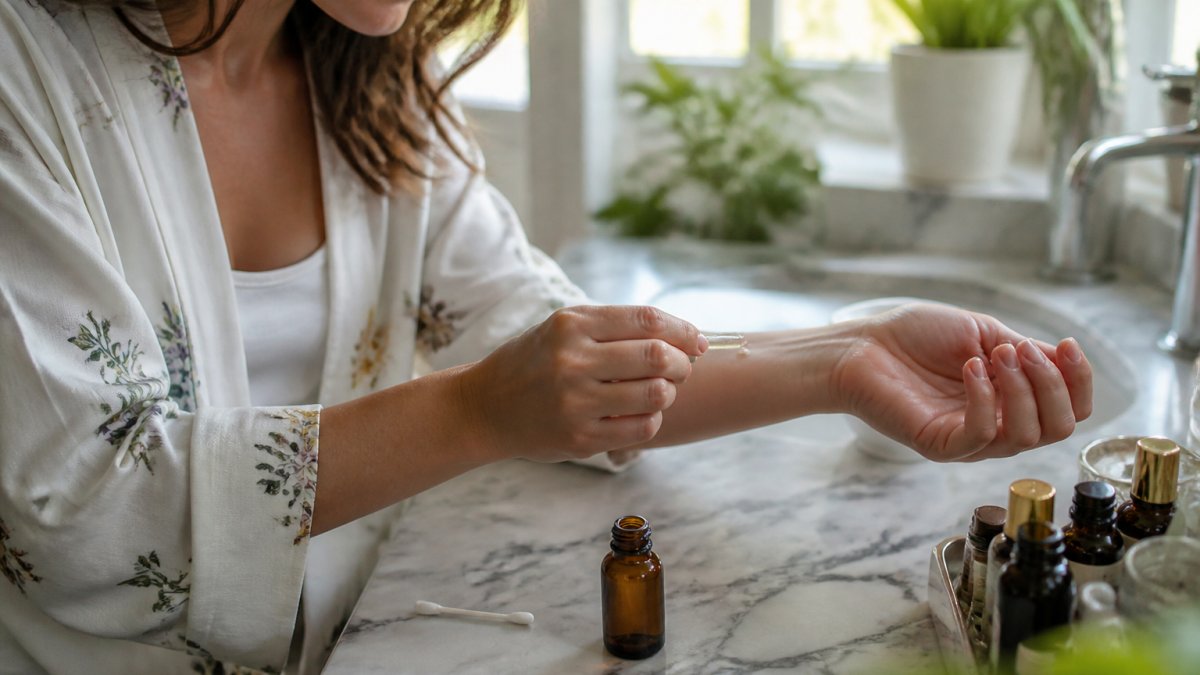
Follow this protocol for every new scent:
- Choose the test site. The inner forearm is standard. Avoid broken, sunburned, or freshly shaved skin.
- Apply a small amount. A pea-sized dab of oil or one spray of mist is enough.
- Leave it uncovered. Covering the patch traps the product against the skin and skews the result.
- Check at 24 hours. Look for redness, swelling, itching, or a bumpy texture.
- Check again at 48 hours. Late reactions are common with fragrance allergy, so the second check is not optional.
- Introduce gradually. If both checks are clear, wear the scent on a small area for a few days before using it normally.
Stop at the first sign of a reaction and wash the area with mild soap. If swelling, blistering, or breathing trouble occurs, seek medical care rather than waiting it out.
Application Methods That Reduce Exposure
Application method changes your exposure as much as the formula does. The same product can be gentle or irritating depending on where and how much you apply.
- Apply to clothing or hair instead of skin. A single spray on a scarf or the ends of your hair gives you scent without direct skin contact.
- Keep it below the jawline. Chest and wrists are lower-risk than neck and face.
- Use less than you think. One dab of oil or one spray of mist is a full application for a light fragrance.
- Skip the pulse-point rub. Rubbing wrists together breaks down the scent and drives the product deeper into the skin.
- Layer over moisturizer. Fragrance applied to moisturized skin spreads more evenly and needs less product to be noticed.
For a spray format, The Natural Eau De Toilette Spray (Tester) by Gap at $18.20 is a woody aromatic built on caraway, vetiver, and bergamot.
Choosing well comes down to matching the format to your trigger. If your skin reacts, starting with an alcohol-free water or a fragrance oil and patch testing first can be helpful.
Frequently Asked Questions
What are some natural substitutes for perfume?
The most common natural substitutes for perfume are fragrance oils, body oils, and hydrosols. Roll-on oils like Lavanila Forever Fragrance Oil ($16.90) and Skin Musk Perfume Oil ($19.60) skip the high alcohol content of conventional sprays. Body oils such as Dr Teal's Lavender Pure Epsom Salt Body Oil ($16.30) add a soft scent while moisturizing. Hydrosols, which are the water left after distilling plant material, give the lightest scent of all and are usually the gentlest on reactive skin.
What perfumes are safe for sensitive skin?
No perfume is universally safe, because reactions depend on your own triggers. A practical approach is to pick formulas with fewer known irritants and test them yourself. Look for alcohol-free options such as Sophie La Girafe Eau De Soin Parfumee ($36.20), which is a scented skincare water. Patch testing on your inner forearm for 24 to 48 hours before wearing it on your neck or wrists, and stopping at the first sign of redness or itching, is recommended.
Can essential oils irritate sensitive skin?
Yes. Essential oils are concentrated plant extracts, and several common ones, including citrus oils and lavender, can cause contact reactions in some people. It is recommended to dilute any essential oil blend before it touches your skin, and to avoid applying it undiluted. If you have a diagnosed fragrance allergy, treating essential oils with the same caution as synthetic fragrance and patch testing each new oil separately can help identify which one causes a reaction.
Is fragrance-free better than natural fragrance for sensitive skin?
It depends on what triggers your reactions. Fragrance-free products contain no added scent at all, which can make them a safer choice if you react to any fragrance, natural or synthetic. Natural fragrance still contains aromatic compounds, and plant-derived ingredients can be allergens too. If your skin tolerates light scent, a hydrosol or an alcohol-free scented water may work. If you react to everything, starting with truly fragrance-free body care and adding scent only after testing is an option.
What can I wear instead of perfume if scents trigger irritation?
You can wear scented body care instead of a spray perfume. A moisturizing body oil like Dr Teal's Nourishing Coconut Oil blend ($16.60) can leave a soft scent on the skin without an alcohol base. A tester-size eau de toilette such as The Natural by Gap ($18.20) lets you try a woody aromatic scent at low cost before committing. Applying scent to clothing or a scarf rather than directly on skin can help cut down contact.
Finding a scent that works with your skin rather than against it takes a little trial, but the payoff is a fragrance you can actually wear. Myriad Mart carries alcohol-free scented waters, roll-on fragrance oils, and moisturizing body oils at prices that make testing more than one option realistic. Browse the fragrance collection to compare formats side by side, and start with a patch test before your first full application. View all.
