Table of Contents
- Why Quality Clothing Is Harder to Judge Online
- How to Check Fabric Quality Online Before You Buy
- Signs of Well-Made Clothing You Can See in a Listing
- How to Read Clothing Reviews Without Getting Fooled
- What to Look for in Product Photos and Size Charts
- Your Clothing Quality Checklist for Any Product Page
- Red Flags in Descriptions and Return Policies
- Putting It Into Practice: A Quality Coat Example
- Conclusion
- Frequently Asked Questions
Last Updated: October 18, 2026
Why Quality Clothing Is Harder to Judge Online
You can't touch the fabric. You can't hold the garment up to the light or check whether the seams lie flat. That's the core problem with buying clothes online, and it's why so many shoppers end up disappointed when the box arrives.
At Myriad Mart, we hear this concern constantly: "It looked nothing like the photos." The good news is that learning how to spot quality clothing online comes down to reading listings the way a buyer for a store would. You look past the styling and the marketing language, and you check the details that reveal how a garment was actually made.
Below, we'll show you exactly how to do that, from fabric composition to return policies. By the end, you'll have a repeatable method for judging quality clothing before you spend a cent.
How to Check Fabric Quality Online Before You Buy
Fabric quality is the foundation of any garment. A beautiful cut in cheap fabric will pill, sag, or lose its shape within a few washes. So start here, before you look at anything else.
Read the Material Composition, Not the Marketing Copy
Ignore words like "luxe," "premium blend," and "designer-inspired." Those are marketing terms, not facts. Scroll to the actual composition list.
Here's what to look for:
- Natural fibers high on the list: Cotton, wool, linen, and silk tend to breathe better and age well.
- Synthetic fibers with a purpose: A little elastane adds stretch. Polyester can add durability. The problem is when synthetics make up nearly everything.
- Vague language: "Fabric blend" with no percentages is a red flag. Reputable sellers list exact percentages.
A 100% polyester jacket can still be a good buy if the price matches. Just know what you're getting. The listing for our Plaid Collared Neck Boucle Jacket states its composition plainly: 100% polyester, machine wash cold. No games, no vague promises.

What Fabric Weight and Stretch Tell You
Weight and stretch are the two specs that predict how a garment will hang and wear.
Fabric weight is usually given in grams per square meter (GSM). Heavier fabrics drape with more structure and resist wrinkling. Lighter fabrics feel airy but can show every bump. If a listing gives no weight at all, look at the photos for clues: does the fabric look thin enough to see light through it?
Stretch matters for fit and recovery. A stretchy knit bounces back after wearing. A stiff woven fabric holds its shape but may feel restrictive. Our Cable-Knit Open-Front Longline Cardigan lists "Stretchy" as a feature, which tells you it will move with you rather than fight you.

Signs of Well-Made Clothing You Can See in a Listing
Construction details separate a garment that lasts from one that falls apart. You can spot most of them in close-up photos.
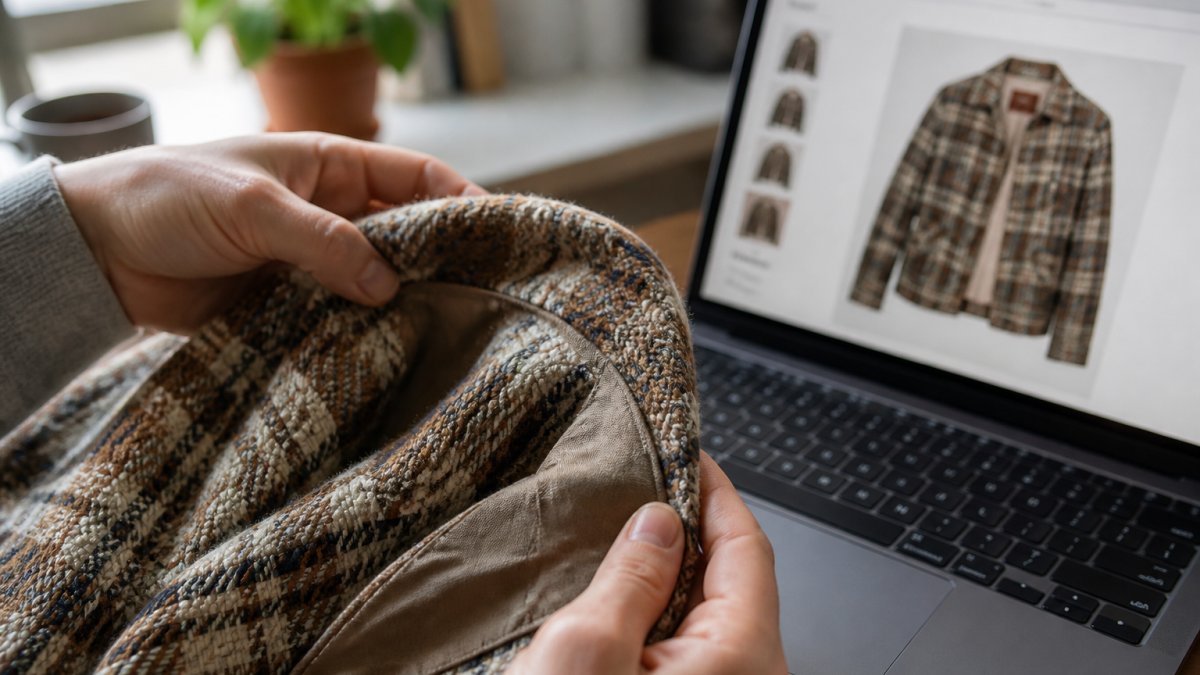
Look for these signs of well-made clothing in every listing:
- Even stitching: Stitch lines should be straight and tight, with no loose threads or skipped sections.
- Pattern matching: On plaid or striped garments, the pattern should line up at the seams. Mismatched patterns mean rushed production.
- Reinforced stress points: Buttons, pockets, and zippers should have extra stitching around them.
- Lined versus unlined: A lining adds structure and hides seams. Unlined is fine for casual pieces, but check whether the listing says so.
Our Double-Breasted Lapel Collar Longline Coat is a useful example. The listing notes it is lined, buttoned, pocketed, and double-breasted. Those are concrete construction facts you can weigh, not adjectives.
How to Read Clothing Reviews Without Getting Fooled
Reviews are useful, but only if you know how to read clothing reviews critically. Most shoppers skim the star rating and stop there. That's a mistake.
Read the two- and three-star reviews first. They tend to be the most balanced, because the reviewer liked some things and disliked others. Five-star reviews can be genuine, but they're also where you'll find the most inflated praise.
Then look for patterns. One person saying a jacket runs small is an opinion. Fifteen people saying it runs small is a fact about the sizing.
Spotting Fake or Incentivized Reviews
Fake reviews follow predictable patterns. Watch for:
- Reviews that describe the shopping experience but never the product
- A burst of five-star reviews posted on the same day
- Generic praise that could apply to any item ("Great quality, fast shipping!")
- Reviews that mention a discount or free product in exchange for feedback
The [Federal Trade Commission's rules on endorsements and reviews | ftc.gov] require sellers to disclose incentivized reviews clearly. If you can't tell whether a review was paid for, treat it with caution.
What to Look for in Product Photos and Size Charts
Photos and size charts are your best substitute for holding the garment. Use them both, and use them together.
HYFVE Plaid Collared Neck Boucle Jacket with Pockets →
On photos, check:
- Whether the same garment appears in multiple lighting conditions
- Close-ups of fabric texture, seams, and hardware
- Whether the model's measurements are listed (so you can judge fit)
- Whether the photo shows the back, the inside, and the label
On size charts, check:
- Whether measurements are given in inches or centimeters, and whether the chart matches the size you'd normally buy
- Bust, waist, and length measurements, not just S/M/L labels
- Whether the seller notes if the garment runs small or large
A listing that gives full measurements is a listing that respects your time. Our Full Size Contrast Trim Tweed Outerwear publishes exact bust and length measurements for every size from S to XXXL, so you can compare them to a garment you already own.

Your Clothing Quality Checklist for Any Product Page
Here's a clothing quality checklist you can run through in about two minutes. Keep it handy the next time you're browsing.
| Check | What Good Looks Like | Red Flag |
|---|---|---|
| Material composition | Exact percentages listed | "Fabric blend" with no details |
| Fabric weight | GSM or clear thickness note | No weight info at all |
| Construction | Even stitching, matched patterns | Loose threads, mismatched plaid |
| Lining | Clearly stated as lined or unlined | Silent on lining |
| Size chart | Full measurements in inches | Only S/M/L labels |
| Reviews | Balanced, with photos | All five-star, no photos |
| Return policy | Clear window and conditions | Restocking fees buried in fine print |
Run this checklist before you add anything to your cart. It takes less time than a return.
Red Flags in Descriptions and Return Policies
Some warnings are loud once you know to listen for them.
Watch for descriptions that spend three paragraphs on lifestyle and one line on the actual product. Watch for return windows that are short or conditional. A seller confident in their quality clothing offers a reasonable return window, because they know most buyers will keep the item.
Also watch for:
- No care instructions. A seller who won't tell you how to wash a garment may not know how it was made.
- Stock photos only. No real product shots means no real inspection.
- Pressure tactics. Countdown timers and "only 2 left" banners on every item are a sales tactic, not a quality signal.
Putting It Into Practice: A Quality Coat Example
Let's walk through a real evaluation using a coat you might actually buy.
Say you're looking at a longline coat. First, you check the composition: 100% polyester, machine wash cold. That tells you it's easy to care for but won't breathe like wool. Next, you check construction: the listing says lined, buttoned, pocketed, double-breasted. Those are real details, and a lined coat holds its shape better than an unlined one.
Then you check the size chart. Bust measurements run from 38.6 to 44.9 inches across S to XL, and length runs about 45 inches. Compare those numbers to a coat you already own. If they line up, you've done your due diligence without ever touching the fabric.
That's the whole method. Composition, construction, measurements, reviews, return policy. Five checks, two minutes, far fewer returns.
Conclusion
The challenge with online shopping is simple: you're buying blind. But blind doesn't mean guessing. Read the composition, study the construction details, compare the measurements, and check the return policy before you commit.
At Myriad Mart, we list exact materials, full measurements, and clear care instructions on every product page, so you can run these checks yourself. Browse our coats and outerwear to see how transparent listings make quality easy to judge. View all and shop with confidence this season.
Frequently Asked Questions
How can you tell if clothing is good quality online?
Start with the material composition, since a listed percentage tells you more than any marketing headline. Look for specific fabric names, check whether the body is lined, and read the measurements instead of trusting a size label. Then scan reviews for comments about pilling, shrinking, or seam failure after washing. A listing that gives you composition, measurements, and care instructions is usually a listing from a seller that expects the garment to last.
How do you use customer reviews to assess clothing quality?
Filter for reviews that mention fit, fabric feel, and what happened after a few washes. Those details are hard to fake and easy to verify against the listing. Skip five-star reviews that only say 'love it' and read the three-star ones, which usually explain exactly what disappointed the buyer. If several reviewers mention the same flaw, such as thin material or a color that arrived darker than pictured, treat that as a pattern rather than a one-off.
What should you check in a clothing store's return policy?
Confirm the return window, who pays return shipping, and whether tags must stay attached. A 30-day window with free returns signals the seller expects most buyers to keep the item. Watch for restocking fees and final-sale labels, since those make a quality gamble expensive. Also check whether the policy covers washed items, because a garment that falls apart after one wash is exactly the case you need covered.
What details indicate that a garment is well made?
Look for matched patterns at the seams, a lining in structured pieces, functional pockets, and buttons sewn with visible thread rather than glued on. Product measurements that include bust, waist, and sleeve length show the seller has actually handled the garment. Care instructions printed on the listing, rather than buried in a photo, are another sign of a seller that stands behind what it ships.
