
Table of Contents
- What You'll Need Before You Start Shopping
- How to Check Fabric Quality Online
- How to Read Clothing Labels for Quality
- Best Online Clothing Stores for Quality
- Investment Pieces vs Fast Fashion: What Lasts
- How to Find Quality Clothing Online Using Reviews and Return Policies
- Sustainable Manufacturing and Ethical Production Certifications
- Shopping Online Without Trying On: Sizing and Fit Tips
- Common Mistakes to Avoid When Buying Quality Clothing Online
- Conclusion
- Frequently Asked Questions
Last Updated: October 2, 2026
What You'll Need Before You Start Shopping
Finding quality clothing online starts with preparation, not browsing. Before you open a single product page, gather three things: your exact measurements, a list of fabrics you actually enjoy wearing, and a clear budget ceiling.
How to find quality clothing online comes down to knowing what you're looking for before you look. Start with these basics:
- Your measurements: Bust, waist, hip, and inseam, taken over light clothing and written down.
- A fabric shortlist: Note which natural fibers and synthetic blends have held up in your existing wardrobe.
- A budget range: Separate what you'll spend on wardrobe staples from what you'll spend on trend-focused pieces.
That last point matters more than most shoppers realize. Consumer guidance on textile labeling from the Federal Trade Commission explains that garment labels must disclose fiber content and country of origin, which gives you a legal basis for verifying claims before you buy.
How to Check Fabric Quality Online
Fabric quality online is judged through measurable data, not marketing adjectives. Most guides stop at "check the fiber content." That is the starting line, not the finish. The shoppers who consistently get good garments out of a product page are the ones reading three numbers: fiber percentages, fabric weight, and weave or knit structure.
Reading Fabric Composition and Fiber Content
Natural fibers like cotton, wool, and linen generally breathe better and age more gracefully than synthetic blends. That doesn't make synthetics bad. A small percentage of spandex or elastane adds stretch and shape retention to an otherwise natural garment.
The rule of thumb: the first-listed fiber makes up the largest share. A cardigan listed as 95% cotton and 5% spandex will feel and behave very differently from one that's 100% acrylic. Both can be good purchases, but they serve different purposes.
Look for retailers that publish full material composition rather than vague terms like "premium blend." Vagueness is a signal, and not a good one.
The Number Most Product Pages Hide: Fabric Weight (GSM)
GSM stands for grams per square meter. It is the single most useful durability number a retailer can publish, and most don't. GSM tells you how much fiber is packed into a given area of fabric, which correlates directly with how a garment drapes, how opaque it is, and how long it survives repeated washing.
Rough working ranges for common knits:
- Lightweight jersey (roughly 120-150 GSM): T-shirt and undershirt territory. Expect some show-through on lighter colors and a shorter lifespan under frequent washing.
- Midweight cotton (roughly 160-200 GSM): The sweet spot for everyday tees and casual tops. Holds shape, resists transparency, and tolerates home laundering.
- Heavyweight cotton (roughly 210-280 GSM): Structured tees, sweatshirts, and workwear-adjacent pieces. Less drape, more longevity.
- Sweater knits (roughly 250-400+ GSM): The higher the number, the warmer and more substantial the knit, and the more likely it will pill if the yarn is short-staple.
These are ranges, not rules. A 180 GSM cotton can outperform a 220 GSM cotton if the yarn is longer-staple and the knit is tighter. But when two similar garments sit side by side and only one page lists GSM, that page is giving you more to work with.
If GSM isn't published, you can estimate it from a few clues: a model shot where the fabric looks thin enough to show the outline of a pocket or undergarment, a description that leans on words like "lightweight" or "airy," or a price that is unusually low for the fiber content claimed.
Weave and Knit Structure: What the Photo Actually Shows
Fiber content tells you what the fabric is made of. Weave or knit structure tells you how it behaves.
- Woven fabrics (poplin, twill, denim, oxford): Two sets of yarns interlace at right angles. Look for a tight, even grid in zoomed photos. Loose, gappy weaves wrinkle more, wear faster at stress points, and show transparency under light.
- Jersey knit: A single knit that curls at the edges when cut. Smooth face, slightly textured back. Prone to stretching out at the neckline if the ribbing is thin.
- Rib knit: Vertical columns of raised texture. Used at cuffs, collars, and hems because it recovers shape. A wide, dense rib outlasts a narrow, loose one.
- Fleece and French terry: Looped or brushed back. Check whether the loops are tight and uniform; loose loops pill quickly.
Spotting Quality Construction in Product Photos
Product photography reveals more than most shoppers notice. Zoom in and check six things, in this order:
- Seam alignment. Follow a side seam from hem to armpit. It should run straight, not wander or pucker.
- Stitch density. Count stitches along an inch of seam in a close-up. Denser, even stitching (roughly 10-14 stitches per inch on most apparel) signals a slower, more controlled machine run than sparse, uneven stitching.
- Pattern matching at seams. On plaids, stripes, or prints, the pattern should line up where panels meet. Misalignment means the cutter prioritized fabric yield over appearance, a reliable proxy for overall cost-cutting.
- Buttonholes and buttons. Buttonholes should be cleanly cut with no frayed edges. Buttons should be sewn with a shank or cross-stitch, not two loose threads.
- Zippers. Look for metal or branded zipper pulls and a smooth tape. Cheap zippers ripple the fabric around them.
- Drape. Fabric that hangs in soft, continuous folds is usually a sign of a balanced weave or knit. Fabric that stands out stiffly or clings unnaturally often signals heavy sizing or a high synthetic content.
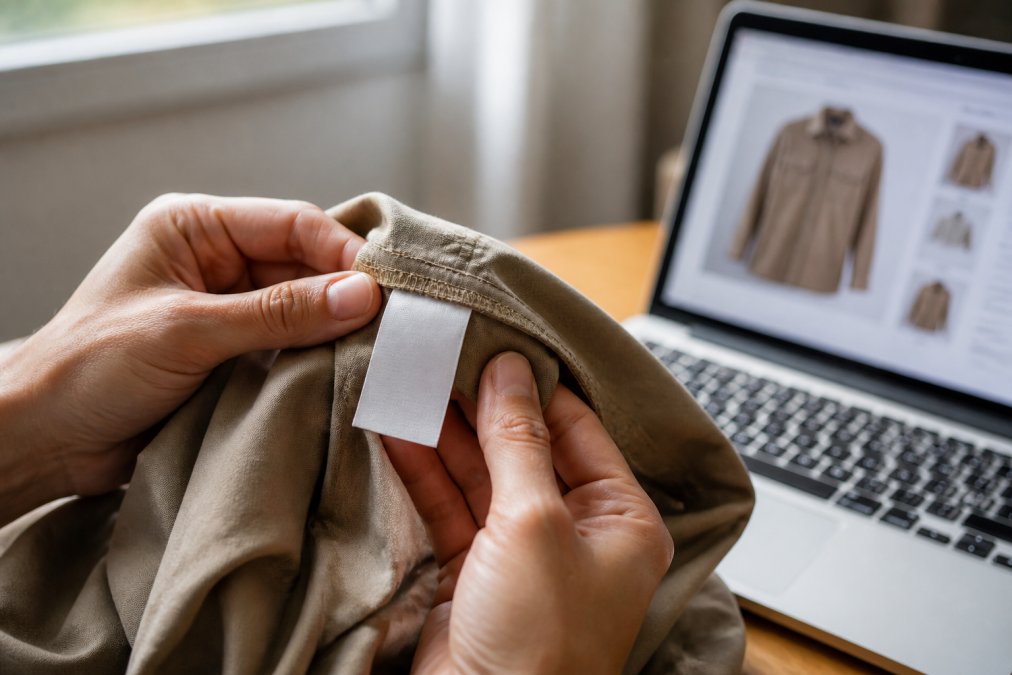
A common mistake is trusting the hero image alone. Look for multiple angles, close-up shots, and ideally a photo of the garment on a real person rather than a mannequin.
A Quick Photo-Zoom Checklist
Before you add to cart, run this five-point scan on the product images:
- Is there at least one close-up of a seam or hem?
- Can you see the fabric's texture, or is it blurred by styling?
- Do patterns align where panels meet?
- Are buttons and buttonholes shown clearly?
- Is there a photo on a real body, not just a mannequin or flat lay?
If a listing fails three or more of these, you are buying on faith. That is sometimes fine for a low-cost trend piece. It is a bad bet for anything you intend to wear for years.
How to Read Clothing Labels for Quality
Clothing labels are the most underused quality tool in online shopping. They tell you fiber content, care requirements, and country of origin, all of which predict how a garment will perform over time.
Decoding Care Instructions and Origin
Care instructions are a durability forecast. "Dry clean only" on a casual knit usually signals a delicate fiber that won't survive home washing. "Machine wash cold, tumble dry low" tells you the manufacturer expects the garment to hold up under normal use.
Country of origin matters less than the quality control behind it. A garment made in a country with established textile manufacturing infrastructure can be excellent. What you're really checking for is retailer transparency. Brands that publish where and how their clothing is made tend to have tighter quality control.
- Machine washable: Expect everyday durability.
- Hand wash or dry clean: Treat as a delicate piece.
- No care label at all: A red flag for quality control.
Best Online Clothing Stores for Quality
The best online clothing stores for quality share three traits: detailed product specifications, transparent material composition, and generous return policies. Price alone tells you very little.
When evaluating a retailer, check whether they publish measurements per size rather than generic size charts. Myriad Mart lists specific bust and waist measurements for each size on items like the Zenana Waffle Open Front Sweater Cardigan, which removes the guesswork that causes most online returns.

| What to Check | Weak Signal | Strong Signal |
|---|---|---|
| Material composition | "Premium blend" | Full fiber percentages listed |
| Sizing | Generic S/M/L chart | Per-size measurements in inches |
| Construction detail | One hero photo | Multiple angles plus close-ups |
| Care instructions | Missing | Specific wash and dry guidance |
| Returns | Store credit only | Full refund window stated |
A retailer that scores well on all five rows is worth your time. One that scores poorly on three or more usually isn't.
Investment Pieces vs Fast Fashion: What Lasts
Investment pieces earn their cost through wear count, not price tag. A $45 cardigan worn twice a week for three winters beats a $15 version replaced every season.
Fast fashion isn't automatically wrong. Trend-focused pieces you'll wear for one season make sense at a lower price point. The mistake is paying investment-piece prices for fast-fashion construction.
Here's how to tell them apart:
- Investment pieces: Natural fiber content, reinforced seams, classic silhouette, machine washable or easily maintained.
- Fast fashion: High synthetic content, minimal seam finishing, trend-specific cut, often dry clean only despite casual styling.
Wardrobe longevity comes from mixing both deliberately. Build a capsule wardrobe of timeless pieces, then layer in trend-focused items you won't mind retiring.
Zenana Waffle Open Front Sweater →
How to Find Quality Clothing Online Using Reviews and Return Policies
Customer reviews and return policies are your two best verification tools. Reviews tell you how a garment performed after washing. Return policies tell you how much risk you're taking.
Read reviews for specific complaints, not star ratings. "Fabric pilled after two washes" is useful. "Love it!" is not. Filter for reviews mentioning fit, sizing accuracy, and durability after several wears.
Consumer protection guidance on online purchase returns from the Federal Trade Commission outlines what sellers must disclose about refund and return terms, so a retailer's policy page should be clear and complete.
Sustainable Manufacturing and Ethical Production Certifications
Sustainability certifications give you a shortcut to verifying manufacturing claims, but only if you know what each one actually audits. Most guides list the acronyms and stop. The useful question is narrower: which certifications tell you something about how long the garment will last, and which only speak to how it was made?
What Each Major Certification Actually Verifies
GOTS (Global Organic Textile Standard). Covers the entire textile supply chain for organic fiber products, from harvesting through manufacturing. It requires a minimum percentage of certified organic fiber, restricts a long list of chemicals at each processing stage, and includes social criteria for workers. For a shopper, GOTS is a strong signal that the cotton or other fiber is genuinely organic and that dyeing and finishing were held to a defined chemical standard. That matters for longevity because harsh finishing chemicals can weaken fibers over time.
OEKO-TEX Standard 100. Tests the finished article, yarn, fabric, and every trim, button, and zipper, for harmful substances. It is a product safety certification, not an organic or labor certification. A garment can be OEKO-TEX certified and still be made from conventional (non-organic) cotton. What it tells you is that the finished item has been tested against a published limit list for substances like formaldehyde, heavy metals, and certain azo dyes. For shoppers with sensitivities, it is the most directly relevant label.
Fair Trade Certified. Focuses on labor and trade terms: fair wages, safe working conditions, no forced or child labor, and often a community development premium. It says nothing about fiber content or chemical processing. Useful if your priority is the people who made the garment; not a durability signal.
Bluesign. A system-level certification for textile supply chains that restricts chemicals and sets resource-use standards at each production step. Common in performance and outdoor apparel. Like OEKO-TEX, it speaks to processing rather than fiber origin.
B Corp. A whole-company certification covering governance, workers, community, environment, and customers. It is not textile-specific. A B Corp apparel brand has met a broad social and environmental bar, but the certification does not audit individual garments.
How to Read a Certification Claim on a Product Page
A real certification claim has three parts: the certification name, the certifying body, and a license or certificate number you can look up. A vague claim has none of them.
- Strong: "GOTS certified organic cotton. License #12345. Certified by [named body]."
- Weak: "Made with organic cotton."
- Strong: "OEKO-TEX Standard 100 certified. Certificate #SH12345678."
- Weak: "Eco-friendly dyes."
Certification numbers are searchable in the public databases maintained by the certifying organizations. If a brand publishes a number and it checks out, that is a verified claim. If a brand uses the logo without a number, treat it as decorative.
Why This Matters for Longevity, Not Just Ethics
Certifications are usually framed as an ethical choice. They are also a durability proxy, for two reasons.
First, chemical processing standards limit the harsh finishes, resins, formaldehyde-based anti-wrinkle treatments, certain dye fixatives, that can shorten a garment's life by weakening fibers or causing them to break down unevenly. A garment held to a stricter processing standard tends to age more predictably.
Second, certification requires supply-chain traceability. A brand that can trace its cotton from farm to finished garment generally also has tighter quality control at each step, because it knows where every input came from. Traceability and consistency tend to travel together.
A Practical Shortcut
You do not need to memorize every certification. Use this filter:
- If fiber origin matters to you: look for GOTS or a comparable organic-fiber certification.
- If chemical exposure matters to you: look for OEKO-TEX Standard 100 or Bluesign.
- If labor conditions matter to you: look for Fair Trade Certified or a published factory list.
- If you just want a general trust signal: a brand that names its certifications, links to the certifying body, and publishes certificate numbers is more reliable than one using vague environmental language, regardless of which certification it holds.
Textile sourcing and ethical production are complex supply chain issues, and no single label captures everything. But third-party certification remains the most reliable signal available to a shopper who cannot visit the factory, and the certificate number is what separates a real commitment from a logo.
Shopping Online Without Trying On: Sizing and Fit Tips
Sizing accuracy improves dramatically when you use garment measurements instead of size labels. A size "M" means nothing across brands. A 37-38 inch bust measurement means the same thing everywhere.
Take your measurements once and keep them saved. Then compare against the per-size chart on each product page.
- Measure over light clothing for the most accurate numbers.
- Check the stretch rating. "Slightly stretchy" gives you a small margin of error; "no stretch" does not.
- Read the fit description. "Relaxed fit" and "fitted" describe silhouette, not size.
- Check the model's height and size when listed, since it shows how the garment sits on a real body.
For pieces like the VERY J Cable Knit Open Front Cardigan, the listed bust and waist measurements per size let you match your own numbers directly rather than guessing.

Common Mistakes to Avoid When Buying Quality Clothing Online
The most expensive mistake online shoppers make is buying on discount alone. A cheap garment that doesn't fit or falls apart after two washes costs more per wear than a full-price piece you keep for years.
Other frequent errors:
- Ignoring material composition because the photos look good.
- Trusting size labels instead of measurements.
- Skipping the return policy until after a problem appears.
- Buying final-sale items without checking construction details.
- Assuming higher price equals higher quality without verifying fiber content.
Price-to-value ratio is the metric that matters. Compare cost per wear, not sticker price.
Conclusion
The gap between a frustrating online purchase and a wardrobe staple comes down to verification: fiber content, construction detail, sizing accuracy, and a return policy that protects you. Myriad Mart stocks seasonal apparel with full material composition and per-size measurements listed, so you can check the details before you commit. Browse the Zenana Button Down Long Sleeve Sweater Cardigan or explore the full collection to see how transparent product listings change the way you shop. View all and find pieces built to last.

Frequently Asked Questions
How can you tell if a garment is high quality from a website?
Look for detailed product photos that show stitching, seams, and fabric texture up close. Check the material composition listed on the product page, and read the care instructions to see if the garment requires special handling. A quality clothing listing will include specific measurements, fabric weight, and construction details rather than vague descriptions. Retailer transparency about materials and manufacturing is a strong signal of quality.
What fabrics should I look for to ensure clothing longevity?
Natural fibers like cotton, wool, and linen generally hold up better over time than synthetic blends, though high-quality synthetics have their place. For example, a cable knit cardigan made from 95% cotton and 5% spandex offers both durability and comfortable stretch. Check the fabric composition carefully: 100% acrylic is affordable and easy to care for but may pill over time, while cotton blends tend to resist pilling and maintain their shape through repeated washing.
Is it possible to find affordable high-quality clothing online?
Yes. Affordable quality clothing exists when you know what to look for. Focus on fabric composition, construction details, and retailer transparency rather than brand names alone. A waffle-knit cardigan at $37.45 made from midweight acrylic can be a solid wardrobe staple if the construction is sound. Compare price-to-value ratio by checking how the garment is made, what materials are used, and whether the retailer offers a fair return policy.
How do I read size charts and fabric compositions effectively?
Start by measuring yourself and comparing those numbers to the retailer's specific size chart, not generic sizing. Fabric composition tells you how the garment will feel and wear: 97% polyester with 3% acrylic will drape differently than 95% cotton with 5% spandex. Pay attention to stretch descriptions like 'slightly stretchy' and care instructions. If a listing says 'dry clean only,' factor that into your long-term cost and convenience.
