Last Updated: October 26, 2026
Quick Summary
To verify clothing quality online, start with the fiber blend and care label, then check fabric weight and measurements before trusting photos. Request close-ups of seams, hems, and closures, and score each listing so clothing quality, not price, drives your decision.
- A listing that skips the fiber blend entirely is a warning sign.
- A heavyweight hoodie listed at 5 oz/yd² is not heavyweight.
- Read three-star reviews first, since they tend to be the most honest.
- A listing scoring 28 or higher on the checklist is a strong buy.
- The Cable-Knit Open-Front Longline Cardigan is 100% polyester at $57.45.
Table of Contents
- Start With Fabric Composition, Not the Photos
- How to Tell If Clothes Are Good Quality From the Listing
- How to Check Fabric Quality Online Using Photos and Specs
- Inspect Stitching, Seams, and Construction Cues
- How to Check If an Online Clothing Store Is Legit
- Use Reverse Image Search to Compare Product Photos
- Review Labels, Tags, and Serial Numbers for Authenticity
- Check Returns, Refunds, and Buyer Protection Before You Pay
- Score Each Listing Before You Add to Cart
- Shop Myriad Mart With a Quality Checklist in Hand
- Frequently Asked Questions
Start With Fabric Composition, Not the Photos
Most shoppers scroll straight to the product photos. That is the wrong place to start. Learning how to verify clothing quality online begins with the fiber blend, because fabric tells you more about how a garment will wear than any styled image ever can. For a deeper same-topic guide, see how to find quality clothing online. The Baymard Institute's apparel UX research found that 90% of apparel sites fail to give shoppers enough visual, size, or fit information to assess a product properly. That is a striking number, and it explains why so many online buys disappoint.
At Myriad Mart, we read listings the same way we would read a care label: composition first, everything else second. A blend of 100% cotton behaves very differently from 100% polyester, and that difference shows up after the first wash. Cotton Incorporated's Global Lifestyle Monitor survey found consumers rated cotton highest for comfort (67%), softness (66%), and perceived quality (59%). Shoppers already trust cotton. The trick is confirming what you are actually buying.
Below, we walk through nine checks that separate a good garment from a listing that only looks good.
How to Tell If Clothes Are Good Quality From the Listing
You can often judge clothing quality from a listing before you ever see the item in person. The description, the fabric details, and the care instructions reveal more than most shoppers realize. A listing that hides these details is a warning sign on its own.
Read the Fiber Blend and Care Label
The fiber blend is the first thing to check. A garment listed as 100% cotton will breathe and soften with wear. One listed as 100% polyester will hold its shape but trap heat. Neither is bad, but you need to know which you are getting.
Then read the care instructions.
- Machine wash cold and tumble dry low suggests a low-maintenance piece.
- Dry clean only signals a delicate fabric that needs care.
- "Do not bleach" is standard, but missing care info entirely is a red flag.
If a listing skips the fiber blend, treat that as a warning. A seller who cannot tell you what a garment is made of probably does not know.
Check Fabric Weight and Thickness Descriptions
Fabric weight tells you how a garment will drape and how long it will last. Listings that mention "thickness: normal" or "heavyweight" are giving you real information. Ones that say nothing tell you nothing.
Thicker fabrics usually hold up better over time. Thin fabrics can pill and wear through faster. Look for words like "midweight," "brushed," or "French terry," which point to a specific feel. For a deeper look at reading these clues, our guide on how to spot quality clothing online expands on what to look for beyond the basics here.
How to Check Fabric Quality Online Using Photos and Specs
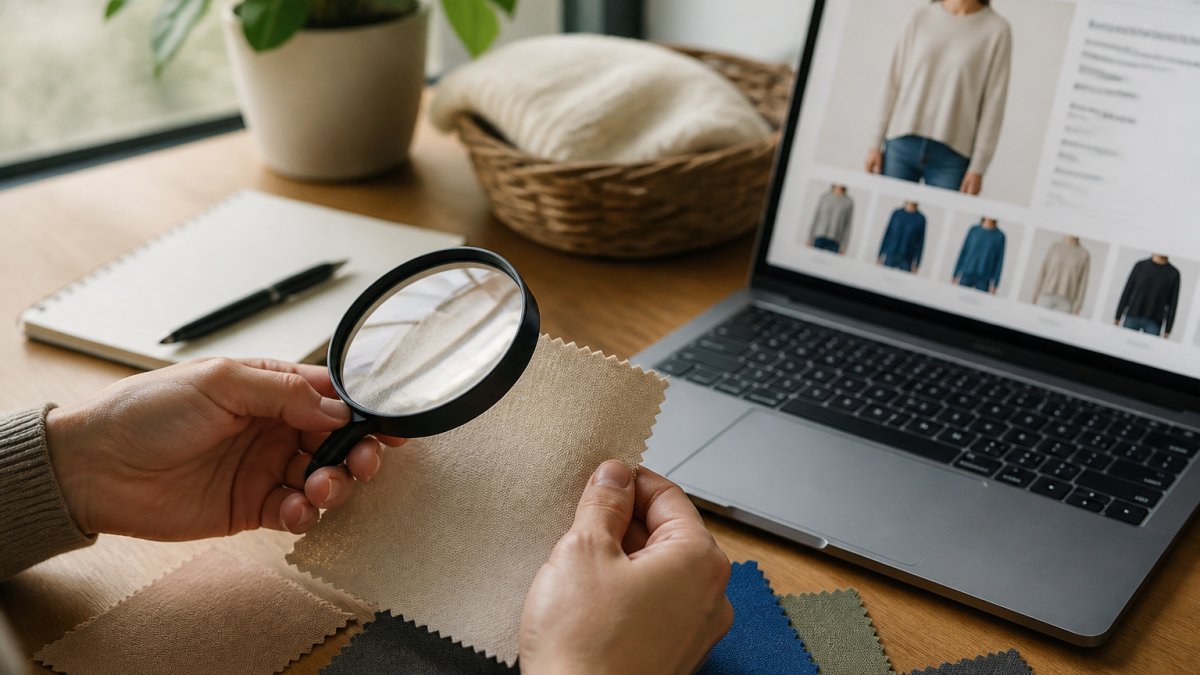
Product photos can reveal fabric quality if you know where to look, but most shoppers stop at the hero shot. The better approach is to treat the listing like a spec sheet: read the numbers first, then use photos to confirm what the numbers claim. This is the step most competitors skip, and it is where you can separate a well-made garment from a pretty one.
Read the Specs Before You Trust the Photos
Start with the fabric weight. Many listings state it in ounces per square yard (oz/yd²) or grams per square meter (GSM). As a rough guide, a lightweight knit often falls around 4-5 oz/yd² (roughly 135-170 GSM), a midweight around 6-8 oz/yd² (roughly 200-270 GSM), and a heavyweight fleece or terry can run 10 oz/yd² (about 340 GSM) or higher. If the listing gives a number, compare it to what you expect for the garment type. A "heavyweight" hoodie listed at 5 oz/yd² is not heavyweight.
Then check the measurements. A listing that gives flat measurements, chest, length, sleeve, waist, is giving you a way to compare against a garment you already own. Measure a similar piece you like, then compare. If the listing only gives alpha sizes (S, M, L) with no numbers, you are guessing.
Finally, read the care instructions against the fiber blend. A 100% cotton garment that says "dry clean only" is unusual and worth questioning. A wool blend that says "machine wash cold" may be treated or blended for easy care. Mismatches between fiber and care are a signal the listing was copied or poorly translated.
The Photo Checklist to Inspect or Request
Use this list to evaluate what the seller already shows, and to request what is missing:
- Fabric close-up: A tight shot of the weave or knit. You should be able to see individual yarns or loops. If the closest photo is a styled full-body shot, ask for a macro image.
- Inside seam: The inside of the garment shows finishing quality, serged edges, bound seams, or raw edges. Sellers who show the inside usually have nothing to hide.
- Hem and cuff: Look for even stitching, clean folds, and no puckering. A wavy hem is a construction warning.
- Closure detail: Zippers, buttons, and snaps should be shown up close. Look for brand names on zipper pulls (YKK is common on better goods) and even buttonhole stitching.
- Lining (if applicable): A lined garment should show the lining fabric and how it is attached at the hem or sleeve.
- Label and care tag: A clear photo of the fiber content and care label confirms the listing text matches the actual garment.
- Color under different light: Ask for a photo in natural light if the listing only shows studio shots, since color accuracy is a common complaint.
If a seller cannot or will not provide these images, treat that as a data point. A legitimate seller with a quality garment can usually produce them.
Match the Photo to the Spec
Once you have both, cross-check them. If the listing says "brushed French terry" but the close-up shows a smooth jersey knit, the description is wrong. If the weight says 8 oz/yd² but the fabric looks thin and sheer against the light, question it. The goal is not to become a textile expert, it is to catch the obvious mismatches that signal a listing you should skip.
For a deeper look at reading these clues across a full store, our guide on how to spot quality clothing online expands on what to look for beyond the basics here.
Inspect Stitching, Seams, and Construction Cues
Stitching is where cheap clothing gives itself away, but you need to know what to look for in a photo. The goal here is to judge the garment on its own merits, not whether it is genuine, but whether it is well made. A genuine item can still be poorly constructed, and a well-made garment can be unbranded. Keep those questions separate.
What Good Stitching Looks Like in a Photo
Zoom in on the seams in the product photos. Even stitching, tight rows, and clean edges signal care. Loose threads, wavy seams, and skipped stitches signal the opposite. Here is what to check:
- Stitch density: Better garments use more stitches per inch. You do not need to count, but rows should look tight and uniform, not sparse and loose.
- Uniform stitching: Rows should be even and consistent in width. A row that wanders or changes width is a warning.
- Reinforced stress points: Pockets, buttons, and zippers should have extra stitching, often a box-X or bar tack at pocket corners and belt loops.
- Clean seam finishes: No fraying or raw edges on the inside. Look for serged (overlocked) or bound seams rather than pinked or raw edges.
- Matching patterns: On plaid or striped items, the pattern should line up at the seams. Misaligned patterns mean the cutter did not take time.
- Hem and cuff finishing: A clean, even hem with no puckering. A wavy or twisted hem is a common defect on inexpensive goods.
How to Evaluate Construction From a Listing
Most listings will not show you the inside of a garment. That is the first thing to note. If the seller shows only the front and back from a distance, you cannot judge construction, and neither can anyone else. Request close-ups of the inside seam, the hem, and any closures.
When you do get photos, compare them to the price and the claims. A garment described as "premium" with sparse, loose stitching is not premium. A basic item with clean, even seams and reinforced stress points is a better bet than a fancy one with sloppy finishing.
Cable-Knit Open-Front Longline Cardigan →
Separate Quality From Authenticity
This is the step most guides miss. Authenticity checks, labels, serial numbers, holograms, tell you whether an item is genuine. They do not tell you whether it is well made. Judge the fabric and construction on their own, then confirm the brand details separately. A counterfeit can be stitched well, and a genuine item can be stitched poorly. Your checklist should score them as two different things.
A listing that shows these details up close is telling you the maker cares. One that only shows the front of the garment from far away is telling you something too.
How to Check If an Online Clothing Store Is Legit
A legit online clothing store shows clear contact details, a real address, and honest reviews. If you cannot find who runs the store or how to reach them, slow down. Scrutinize before you pay.
Scrutinize the URL, Contact Details, and Reviews
Start with the website URL. A misspelled or odd domain is a warning. Then look for a contact page with a real email, phone number, and business address. Stores that hide this info are harder to trust.
Reviews need a closer look too:
- Read the three-star reviews first. They tend to be the most honest.
- Watch for reviews that all sound the same, which can signal fakes.
- Check whether the store responds to complaints.
A store with real reviews and a reachable team is a safer bet. One with perfect ratings and no contact info is not.
Use Reverse Image Search to Compare Product Photos
Reverse image search is one of the fastest ways to catch a listing that borrowed its photos. Save the product image, then run it through a visual search tool like Google Lens. If the same photo shows up on many unrelated stores, the seller may not be the original source.
This check takes under a minute and saves a lot of grief. It also helps you compare product photos against reference images from the brand. If the item claims to be from a known label, the photos should match that label's own shots. Mismatches are a warning sign worth heeding.
Review Labels, Tags, and Serial Numbers for Authenticity
Authenticity checks matter most for branded and luxury clothing. Real labels have clean stitching, even fonts, and consistent spacing. Counterfeit labels often have blurry text, crooked stitching, or misspellings.
Check these details:
- Serial numbers: Many brands use them, and they should match across the tag and packaging.
- Tag placement: Genuine tags sit in consistent spots.
- Holograms or security tags: Some brands include them, and they should look crisp.
Separate garment quality from brand authenticity. A piece can be well made and still not be genuine. Judge the fabric and construction on their own, then confirm the brand details separately.
Check Returns, Refunds, and Buyer Protection Before You Pay
Good return terms are a safety net. Before you pay, read the return window, the refund process, and who covers shipping. A store that makes returns easy is usually confident in its products.
Look for:
- A clear return window, stated in days.
- A refund policy that says how and when you get your money back.
- Buyer protection from your payment method, such as a credit card or a trusted payment platform.
If the return policy is vague or hidden, treat that as a warning. Pair this check with smart timing by reading our guide on how to shop seasonal sales so you know when a deal is real and when it is not.
Score Each Listing Before You Add to Cart
A simple scoring system keeps you consistent. Rate each listing on the checks above, then compare the totals before you buy. This turns a gut feeling into a repeatable process.
| Check | What to Look For | Score (1-5) |
|---|---|---|
| Fiber blend | Full composition listed | 1-5 |
| Fabric weight | Thickness or weight stated | 1-5 |
| Photos | Clear close-ups of texture and seams | 1-5 |
| Stitching | Even, reinforced, clean | 1-5 |
| Store legitimacy | Contact details and real reviews | 1-5 |
| Authenticity | Labels and serial numbers match | 1-5 |
| Returns | Clear window and refund terms | 1-5 |
Add the scores. A listing that scores 28 or higher is a strong buy. Anything under 18 deserves a second look or a pass. This framework keeps clothing quality at the center of every decision, not the sale price.
Shop Myriad Mart With a Quality Checklist in Hand
With a checklist ready, you can browse with confidence. At Myriad Mart, our listings spell out fiber blends and care instructions so you can run these checks without guesswork.
Take our Cable-Knit Open-Front Longline Cardigan, listed at $57.45. The listing states 100% polyester, machine wash cold, and tumble dry low, plus full measurements. That is exactly the kind of detail that lets you judge clothing quality before you buy. Prefer cotton? Our Mittoshop Mineral Wash French Terry Elbow Patch Shacket at $64.45 is 100% cotton with a mineral wash finish.


Ready to put the checklist to work? Browse our women's clothing and accessories or our men's clothing and accessories to apply these checks to real listings.
Frequently Asked Questions
How do I know if clothes are good quality when shopping online?
Start with the fabric composition and care label. A 100% cotton garment like the Mittoshop Mineral Wash French Terry Shacket ($64.45) tells you more about breathability and durability than any marketing photo. Check fabric weight or thickness notes, look for clear close-up photos of stitching, and read the return policy before buying. Cotton Incorporated's Global Lifestyle Monitor survey found consumers rated cotton highest for comfort (67%) and softness (66%), which makes fiber content a reliable first filter for clothing quality.
How can I tell whether clothing fabric is durable from a product description?
Look for specific fiber blends, thickness labels like normal or heavy, and care instructions. A 95% polyester, 5% spandex blend such as the Men's Plus Size Plaid-Lined Hooded Zip-Up Jacket ($61.45) signals stretch and shape retention, while a 100% polyester knit like the Cable-Knit Open-Front Longline Cardigan ($57.45) points to easy machine washing and low wrinkle risk. Vague descriptions with no composition listed are a warning sign that the fabric quality is unverified.
How can I tell if an online clothing store is legitimate?
Check the website URL for secure encryption, read the contact page for a real address or phone number, and scan customer reviews across multiple sources. A legitimate store lists full product measurements, material composition, and a clear return window. Baymard Institute reports that 90% of apparel sites fail to give shoppers enough visual, size, or fit information, so a store that publishes detailed specs and measurements provides valuable transparency.
Can a QR code or clothing label confirm a garment's quality?
A QR code or label can confirm authenticity and traceability, but it does not measure quality. Use labels to verify fiber content, country of origin, and care instructions, then judge construction separately by inspecting seams, stitching uniformity, and fabric finish in product photos. Authenticity and quality are two different checks, and a genuine label on a poorly constructed garment still means poor clothing quality.
The difference between a good online buy and a disappointing one often comes down to a few minutes of checking. Myriad Mart makes that easier with clear fabric details, honest descriptions, and a curated selection across fashion, accessories, and more. Get started with Myriad Mart and shop with a checklist in hand, so every order matches what you expect.

