
Table of Contents
- 1. Start With the Right Question: What Does 'Premium' Actually Mean?
- 2. How to Choose a Perfume: Match the Scent to Your Life, Not the Label
- 3. Perfume Concentration Types: Parfum, EDP, EDT, and Cologne Explained
- 4. How to Test Perfume Before Buying: A Structured Sampling Plan
- 5. A Premium Fragrance Budget: The 30/50/20 Value Framework
- 6. How to Spot Fake Perfume Before You Pay
- 7. Skin Chemistry, Climate, and Real Performance Expectations
- 8. Ten Premium Fragrances Worth Sampling in 2026
- 9. Storage, Returns, and Post-Purchase Care
- Frequently Asked Questions
Last Updated: October 14, 2026
1. Start With the Right Question: What Does 'Premium' Actually Mean?
Premium is not a price tag. It is a set of decisions about ingredients, concentration, and how long a scent stays on your skin. That distinction matters when you are looking for tips for buying premium fragrances, because the word "premium" gets attached to everything from a $20 body spray to a $500 extrait. At Myriad Mart, we see shoppers every week asking the same question: how do I know the difference before I pay? Below, we break down what actually separates a premium fragrance from a well-marketed one.
Three things separate a premium fragrance from an ordinary one:
- Concentration. More fragrance oil per bottle means a longer wear time.
- Sourcing. Named ingredients, not a generic "fragrance" catch-all.
- Formulation. The blend is built to develop over hours, not fade in twenty minutes.
A $19.77 refillable concentrate and a $467 extrait can both be premium. What they cannot both be is interchangeable. Understanding your own priorities is the first real step, and it is the one most shoppers skip.
2. How to Choose a Perfume: Match the Scent to Your Life, Not the Label
How to choose a perfume comes down to one question: where will you actually wear it? Most people buy for the version of themselves they imagine, not the one who shows up to work on Tuesday. That gap is why so many bottles sit half-used on a dresser.
Start with an honest inventory of your week. Then match the scent to the setting.
Map Your Occasions: Daytime Wear vs. Evening Wear
Daytime wear usually calls for lighter, fresher compositions that stay close to the skin. Evening wear can carry heavier notes: amber, leather, oud, resins. A woody-spicy leather like 17/17 Stone Label Homme by Xerjoff ($291.80) reads as evening. A bright floral-citrus like Acqua Fiorentina by Creed ($275.00) works in daylight.

Season and Climate Change Everything
Heat amplifies a fragrance. A scent that feels elegant in January can feel overwhelming in July. Cooler months suit amber and spice, which is why 1888 Casamorati by Xerjoff ($113.00) is built for autumn and winter and transitions from day to night. Warmer months reward citrus and green notes. If you live somewhere humid, expect your fragrance to project further than it does in dry air.
3. Perfume Concentration Types: Parfum, EDP, EDT, and Cologne Explained
Perfume concentration types describe how much fragrance oil is dissolved in the alcohol base, and that number sets your wear time. Higher concentration generally means fewer sprays, deeper development, and a higher price per bottle.
| Concentration | Typical Oil Level | Wear Time | Best For |
|---|---|---|---|
| Parfum / Extrait | Highest | Longest | Evening, cool weather, statement wear |
| Eau de Parfum (EDP) | High | Long | Most occasions, the everyday default |
| Eau de Toilette (EDT) | Moderate | Medium | Daytime, warm weather, office |
| Cologne | Lowest | Shortest | Fresh top-up sprays, hot days |
An extrait de parfum is the most concentrated format, and Alibi V by V Canto ($97.40) is an example: a woody unisex extrait that opens with cypress, mandarin orange, bergamot, and salt. Eau de parfum sits one step below and covers most of what people actually wear, including African Leather by Memo ($170.64), a unisex leather built on bergamot, cardamom, saffron, and oud.
4. How to Test Perfume Before Buying: A Structured Sampling Plan
How to test perfume before buying is the step that saves the most money, and it takes a week, not a minute. A paper strip tells you what a fragrance smells like in the bottle. Your skin tells you what it smells like on you. Those are rarely the same thing.
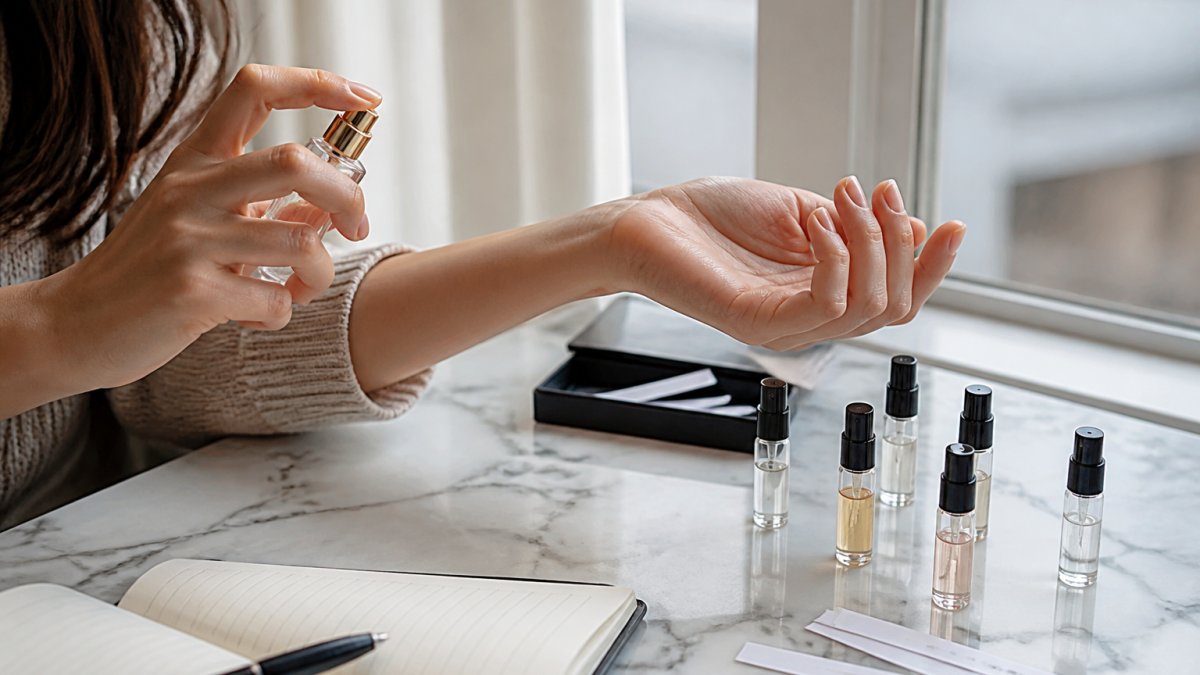
Here is the sampling plan we would run before committing to a full bottle:
- Order samples or decants first. A 2ml decant costs a fraction of a full bottle and gives you three to five wearings.
- Test one fragrance per day. Testing three at once muddles your nose and your notes.
- Spray on skin, not clothing. Fabric holds scent differently and hides how it reacts with your body.
- Wait for the dry-down. Give it at least four hours before you judge it.
- Write it down. Note the opening, the heart, and how it smelled at hour six.
- Re-test in your real environment. A fragrance you loved in a store may read differently at your desk.
- Decide on day seven. If you still want it after a week, it is worth the bottle.
The 7-Day Skin Test: One Scent, Three Wearings
Pick one fragrance and wear it three separate times across the week. Wear it once to work, once on a weekend, and once in the evening. Three wearings reveal more than thirty minutes at a counter ever will. This is also how you learn whether a scent triggers headaches or reads too heavy for a closed office. For a wider look at how fragrance interacts with skin, the American Academy of Dermatology's guidance on fragrance and skin sensitivity is worth reading before you commit.
5. A Premium Fragrance Budget: The 30/50/20 Value Framework
A premium fragrance budget works best when you split it by purpose rather than by brand. Most people overspend on the bottle they wear least. We use a simple split we call the 30/50/20 framework, and then we run the math so the split is not just a slogan.
- 30% on a signature scent. One bottle you wear several times a week. This is your workhorse.
- 50% on sampling and decants. This sounds backwards, but sampling is what stops you from buying a $461 bottle you never reach for. Spend here first.
- 20% on a statement bottle. The one for occasions, evenings, and cooler months.
Why Sampling Gets Half the Budget
A 2ml decant typically costs a small fraction of a full bottle and gives you three to five wearings. That is the entire point: you are buying information, not volume. If a full bottle runs $170 and a 2ml decant runs a few dollars, then three decants cost less than one full bottle and tell you which of three scents you actually want. The math favors sampling every time you are unsure.
The Value Math: Price Per Milliliter, Not Price Per Bottle
A $97 bottle and a $170 bottle are not comparable until you divide by size. Price per milliliter is the only honest way to compare premium options across formats.
- A 50ml bottle at $170 works out to about $3.40 per milliliter.
- A 100ml bottle at $191 works out to about $1.91 per milliliter.
- A 2ml decant at a few dollars is a high price per milliliter, but you are paying for a test, not a supply.
The larger bottle usually wins on price per milliliter, but only if you will actually finish it. A 100ml bottle you wear twice a year is worse value than a 50ml you wear weekly, even though the per-milliliter number looks better.
Concentration Changes the Value Equation
Concentration affects how many sprays you need per wearing, which affects how long a bottle lasts. A higher-concentration extrait often needs fewer sprays than an eau de toilette, so a smaller, pricier bottle can last a comparable number of wearings. Compare bottles by cost per wearing, not cost per bottle: divide price by the number of wearings you realistically expect. A $97.40 extrait worn 100 times is about $0.97 per wearing. A $19.77 refillable concentrate worn 40 times is about $0.49 per wearing. Both can be smart buys; they just serve different habits.
A Worked Example
Say you set aside a monthly fragrance amount. Under the 30/50/20 split, roughly half goes to samples and decants, 30% to your signature bottle, and 20% to a statement piece. If you send half to samples, every full bottle you eventually buy is one you have already worn three times. That is how you avoid the dresser graveyard, and it is how the split pays for itself.
6. How to Spot Fake Perfume Before You Pay
How to spot fake perfume comes down to the packaging, the price, and the seller. Counterfeit fragrance is a real problem in online retail, and most of the tells are visible before you open the box. But the tells only help if you know what to check and in what order. Here is the sequence we would run through before paying.
Tom Ford Oud Wood Eau De Parfum Spray By Tom Ford →
Step 1: Vet the Seller Before You Look at the Bottle
The seller matters more than the listing. A perfect product photo means nothing if the seller is anonymous. Before you add to cart, confirm:
- A real return policy. Look for a stated window (commonly 14 to 30 days) and whether opened fragrance is eligible. A seller who will not accept an opened return is telling you something.
- A physical business address and contact method. Legitimate retailers publish both. A contact form alone is a weak signal.
- Consistent catalog and pricing. If one listing is 60% below retail while the rest of the store is normal, that listing is the outlier, not the deal.
- Authorized-dealer status. Many houses publish a list of authorized retailers. If the seller is not on it, treat the purchase as higher risk.
Step 2: Read the Listing for Missing Specifics
A legitimate premium listing tells you the concentration, the size in milliliters, the house, and the batch or production details. If any of those are missing, vague, or inconsistent between the title and the description, that is your answer. Counterfeit listings often reuse stock photos, crop out the box, or describe a "tester" or "unboxed" unit without explaining what that means for the seal.
Step 3: Inspect the Packaging Against These Checks
- Price that is too far below retail. A deep discount on a current release is a warning, not a win. Established houses rarely discount current releases heavily through unknown channels.
- Batch code mismatch. The code on the bottle should match the code on the box. A mismatch is one of the clearest signs of a repackaged or counterfeit unit.
- Sloppy printing. Crooked labels, blurry text, uneven font weight, and misspelled house names are common on knockoffs.
- Weak or missing cellophane. Authentic bottles are sealed consistently. Loose, cloudy, or resealed wrap is a red flag.
- No ingredient list or address. Legitimate packaging carries full labeling, including the manufacturer's address.
- Atomizer and cap fit. A cap that wobbles, an atomizer that sprays unevenly, or a collar that does not sit flush often points to a non-authentic unit.
Step 4: Know What to Do If It Arrives Wrong
The Federal Trade Commission's guidance on counterfeit goods explains why buying from an unverified seller leaves you with little recourse. If a bottle arrives and fails the checks above, document everything before you use it: photograph the box, the batch code, the label, and the listing. Then request a return in writing through the platform or the seller's stated process. Paying with a credit card gives you a dispute path that cash or peer-to-peer transfers do not.
Buy from a retailer that stands behind what it ships and publishes clear product details. If a listing cannot tell you the concentration, the size, and the house, that is your answer.
7. Skin Chemistry, Climate, and Real Performance Expectations
Skin chemistry changes how a fragrance performs, and so does the weather. Two people wearing the same eau de parfum can get wildly different wear times. Oily skin tends to hold scent longer. Dry skin releases it faster. Humidity increases projection. Cold air mutes it.
This is why performance claims on a bottle should be treated as a range, not a promise. Longevity is how long a fragrance lasts. Projection is how far it reaches. Sillage is the trail it leaves behind. A fragrance with strong projection and short longevity behaves very differently from one that sits close for eight hours.
If you want more from a scent, apply to moisturized skin and pulse points. Do not rub your wrists together; that crushes the top notes and speeds the fade. Store bottles away from direct sunlight and heat, which degrade the formula over time. For context on how fragrance ingredients are regulated and labeled, the FDA's information on cosmetics and fragrance labeling is a useful reference.
8. Ten Premium Fragrances Worth Sampling in 2026
Ten premium fragrances worth sampling in 2026 span a wide price range, and every one of them is a candidate for a decant before a full bottle. Here is what we would put on a sampling list, with prices as listed at Myriad Mart.
| Fragrance | Format | Price | Best For |
|---|---|---|---|
| Tom Ford Oud Wood | Eau de Parfum | $191.00 | Bold, exotic evening wear |
| 17/17 Stone Label Richwood (Xerjoff) | EDP, unisex | $467.00 | Woody citrus, shared wear |
| 17/17 Stone Label Elle (Xerjoff) | EDP | $461.00 | Floral oriental, smoky leather |
| 17/17 Stone Label Homme (Xerjoff) | EDP | $291.80 | Woody spicy leather, evening |
| 1888 Casamorati (Xerjoff) | EDP, unisex | $113.00 | Autumn and winter, day to night |
| 100 Bon Carvi & Jardin De Figuier | Refillable concentrate | $19.77 | Fruity-sweet everyday wear |
| Acqua Fiorentina (Creed) | EDP | $275.00 | Fruity floral, daytime |
| African Leather (Memo) | EDP, unisex | $170.64 | Complex leather, cool weather |
| Alibi V (V Canto) | Extrait de parfum | $97.40 | Fresh woody extrait |
| Ambre Sultan (Serge Lutens) | EDP, unisex | $87.80 | Deep amber, evening |
The range here is the point. 100 Bon Carvi & Jardin De Figuier at $19.77 and 17/17 Stone Label Richwood at $467.00 are both premium by construction. They simply serve different budgets and different moments. Ambre Sultan by Serge Lutens ($87.80) sits in the middle: an amber built on coriander, sandalwood, bay leaf, patchouli, resins, and myrrh, deep enough for evening and priced for a first serious bottle.

Samples, Decants, or Full Bottles? A Decision Tool
Use this to decide what to buy at each stage:
- If you have never worn the scent: buy a sample. Never a full bottle.
- If you have worn it three times and still love it: buy a decant, and keep testing.
- If you have finished a decant and still want it: buy the full bottle.
- If you wear it more than twice a week: the full bottle is the cost-effective choice.
- If it is a seasonal or occasion scent: stay with decants and refillable formats.
9. Storage, Returns, and Post-Purchase Care
Storage decides how long your bottle stays good. Keep fragrance in a cool, dark place, upright, with the cap tight. Bathrooms are the worst spot in the house: heat and humidity break down the formula faster than anything else. A bedroom drawer or a closet shelf works better.
Returns matter just as much. Before you buy, read the retailer's policy on opened fragrance. Many sellers will not accept a returned bottle once the seal is broken, which is another argument for sampling first. Know the window, know the condition requirements, and keep your packaging until you are sure.
Refillable formats deserve a mention here. A refillable concentrate like 100 Bon Carvi & Jardin De Figuier ($19.77) lets you keep the bottle and replace the contents, which cuts both cost and packaging over time. If you plan to collect fragrances, refillables and decants stretch a budget further than full bottles alone.
Buying premium fragrance is a sampling problem before it is a spending problem. The shoppers who end up with a shelf they love are the ones who test on skin, wait for the dry-down, and buy fewer bottles with more confidence. Myriad Mart carries a curated range of premium fragrances alongside fashion, accessories, and home pieces, all in one place and at prices that make sampling realistic. Browse the collection, start with a decant or two, and let your skin make the final call. View all and find your next signature scent.
Frequently Asked Questions
How can I tell whether a premium fragrance is worth the price?
Break the price into cost per wearing. A $191 bottle of Tom Ford Oud Wood worn twice a week for a year works out to under $2 per wear, which is cheaper than most daily coffee habits. Compare longevity, projection, and how often you reach for it. If a scent sits unused because it only suits one season or occasion, the price per wear climbs fast. Sampling first is the cheapest way to protect that math.
How should I test a perfume before buying it?
Spray on skin, never just paper. Apply to one wrist and let it develop for at least four hours so you can judge the dry-down, not just the opening. Test one fragrance per day so scents do not overlap. If possible, ask for a sample vial and wear it three separate times across a week. This is how to test perfume before buying without relying on a five-minute mall impression.
What is the 30/50/20 rule for perfume?
It is a rough budgeting guideline: spend about 30% of your fragrance budget on samples and decants, 50% on full bottles you have already tested, and keep 20% in reserve for seasonal releases or a scent you discover mid-year. The exact split is flexible, but the principle holds. Most buyers overspend on blind buys and underspend on sampling, which is the opposite of what saves money.
How do I spot fake perfume when shopping online?
Check the seller's reviews for complaints about longevity or packaging, confirm the batch code on the box matches the bottle, and look closely at cellophane seals and font quality. Counterfeit fragrances often have crooked labels, weak sprayers, or alcohol-heavy openings that fade in under an hour. Buy from a trusted source with a return policy, and if the price is dramatically lower than every other listing, treat that as a warning sign.
Does skin chemistry really change how a fragrance smells?
Yes. Body heat, natural oils, and pH all affect how top notes, heart notes, and base notes unfold on your skin. The same eau de parfum can smell sweeter on one person and smokier on another. Climate matters too: heat amplifies projection, so a heavy oud worn in summer can overwhelm a room, while the same scent in winter reads warm and refined. Always test on your own skin.
